


Why This Market Is Structurally Different From Every Prior Cycle
Biopharma M&A has experienced fast quarters before. What makes Q1 2026 distinctive is not the volume of deals or even the aggregate value — it is the combination of deal velocity and deal complexity. Fourteen transactions of at least $500 million in a single quarter, in an environment simultaneously characterized by Section 232 tariff uncertainty, a partially revised HSR regulatory process, reinstated FTC early termination practice, and a macro background that was being described as potentially deteriorating, means that legal teams were executing complex transactions faster than the external environment had settled.
Three structural features of this market created the specific legal infrastructure demands I want to examine:
Feature 1: The Trump FTC Reinstatement of Early Termination
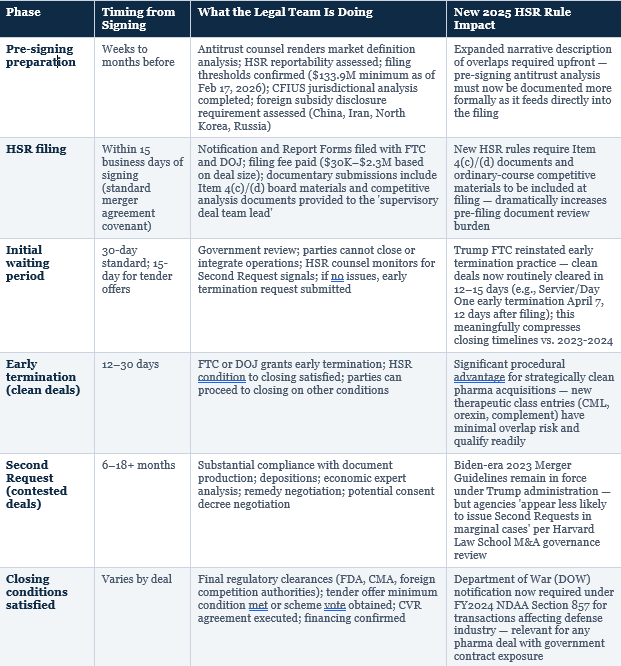
For two years under the Biden administration, the FTC refused to grant early termination of the HSR waiting period — meaning clean deals that would previously close in 12-15 days were instead waiting out the full 30-day initial review period. The Trump FTC reversed this practice. For strategically clean pharma acquisitions — particularly those involving new therapeutic class entries with no competitive overlap in the buyer’s existing portfolio — early termination is now routinely available again. The Servier/Day One acquisition illustrates this precisely: HSR filed March 26, early termination granted April 7. Twelve days from filing to HSR clearance. That is not luck — it is the output of antitrust counsel correctly assessing the competitive landscape and positioning the filing for early termination from the start.
Feature 2: The New HSR Rules Are Now Fully Operational
The revised HSR form that took effect February 10, 2025 dramatically increased the upfront information burden on filing parties. The new rules require: explicit narrative descriptions of deal rationale and competitive overlaps; Item 4(c) and 4(d) documents provided to the ‘supervisory deal team lead’ (essentially every board presentation and competitive analysis prepared in connection with the deal); and ordinary-course documents provided to the CEO and board about competition in overlap areas. This means the document review and privilege analysis that used to happen during a Second Request now happens before the initial filing. For legal teams running parallel M&A processes — as multiple large pharma companies were doing in Q1 2026 — this front-loaded burden is substantial. The HSR function has become a pre-filing document management process, not just a notification filing.
Feature 3: Cross-Border Structure Complexity Is Increasing
The Lilly/Centessa deal introduced a dimension that every pharma M&A CLO needs to understand for the future: the UK Scheme of Arrangement. Centessa Pharmaceuticals plc is a company registered in England and Wales, and the acquisition is being executed as a scheme of arrangement under English law, sanctioned by the High Court of Justice. This is fundamentally different from a Delaware tender offer or merger. It requires a court sanction hearing, a shareholder vote under UK Takeover Code rules, UK Competition and Markets Authority review (in addition to U.S. HSR review), and a different timeline architecture. As European biotechs with U.S.-listed securities become more common acquiree targets, the UK scheme of arrangement and its equivalents in other European jurisdictions will appear with increasing frequency in pharma deals. U.S. pharma CLOs who have only run Delaware transactions are underprepared for this structure.
THE PACE PARADOX
Fourteen deals of at least $500 million in one quarter can sound like a market in which legal teams have abundant opportunities to execute. In practice, the pace creates a specific operational problem: the same senior pharma M&A attorneys who are required to manage these deals are being pulled into multiple transactions simultaneously. The legal function bottleneck in a fast M&A market is not expertise — it is capacity. The CLO who has pre-positioned outside counsel relationships, pre-negotiated engagement terms, and pre-cleared conflicts can deploy that capacity in 48 hours. The CLO who has not will spend 5 of those 48 hours on engagement logistics.
The Four Deals: Legal Infrastructure at a Glance
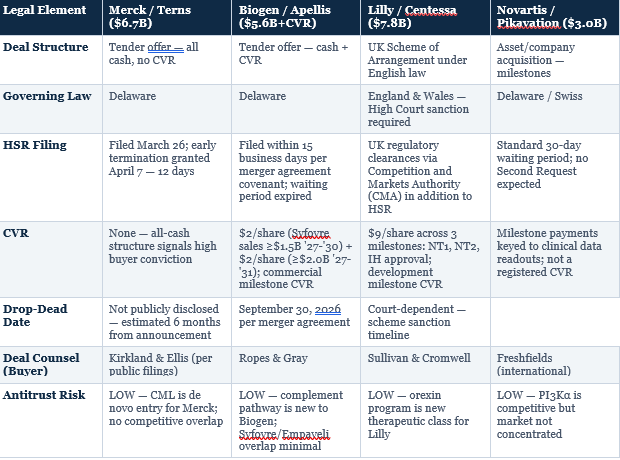
Each of the four major Q1 2026 deals presents a distinct legal infrastructure profile. The comparison table below maps the structural elements side by side — deal structure, governing law, HSR mechanics, CVR architecture, and antitrust risk profile — before we go deeper on each.
DEAL 1
Merck → Terns Pharmaceuticals $6.7B (all-cash, no CVR)
STRUCTURE: Tender offer. All-cash consideration of $53.00 per share. No contingent value right. Merck’s third acquisition of at least $6.7 billion in ten months, following acquisitions of Harpoon Therapeutics and EyeBio in 2025.
HSR STATUS: Filed March 26, 2026 (one day after announcement). Early termination granted April 7, 2026 — twelve days from filing, thirty days ahead of the standard waiting period expiration. FTC’s reinstatement of early termination practice directly accelerated the closing timeline.
EXPECTED CLOSING: Expected Q2 2026 — HSR clearance complete; no remaining major regulatory conditions
LEGAL INFRASTRUCTURE INSIGHT: The all-cash, no-CVR structure is the legal team’s clearest signal of buyer conviction. When a $6.7B acquirer declines to share upside through a CVR in a Phase 1/2 asset acquisition, it means two things: the buyer has high internal conviction in the asset’s value, and the buyer’s legal team concluded that the ongoing CVR administration obligations — trustee appointment, milestone definition, reporting, dispute resolution — were not worth the risk reduction benefit. In a fast market where deal teams are stretched, the administrative overhead of a CVR is a real cost. Merck made the judgment that it was cheaper to pay full price and close clean.
DEAL 2
Biogen → Apellis Pharmaceuticals $5.6B + up to $4.00 CVR
STRUCTURE: Merger agreement — Biogen tender offer for Apellis Common Stock at $41.00 per share. CVR of up to $4.00 per share in two commercial milestone tranches. Merger agreement signed March 31, 2026. Apellis is a Delaware corporation.
HSR STATUS: Filed within 15 business days of signing per merger agreement covenant (standard). Standard 30-day waiting period. Waiting period expired or early termination expected Q2 2026. The Apellis merger agreement expressly provides that the deal must close by September 30, 2026, establishing a hard drop-dead date.
EXPECTED CLOSING: Q2 2026 — targeting close before September 30 drop-dead
LEGAL INFRASTRUCTURE INSIGHT: The commercial milestone CVR structure in this deal is legally more complex than a clinical milestone CVR because it requires ongoing Syfovre net sales monitoring against defined thresholds across a multi-year period. The CVR agreement will designate a trustee, define net sales calculation methodology with specificity (what is included, what is deducted, how foreign currency conversions are handled, how competitor promotional spending affects calculation), and establish a dispute resolution process for each milestone determination. The CLO who inherits this agreement 18 months from now — when the first milestone evaluation year begins — needs to understand what Biogen’s CVR counsel negotiated in the definition of ‘global net sales’ down to the comma. That definition will determine whether $2/share is paid or disputed.
DEAL 3
Eli Lilly → Centessa Pharmaceuticals $6.3B upfront + $1.5B CVR ($7.8B total)
STRUCTURE: UK Scheme of Arrangement under the laws of England and Wales. Not a U.S. tender offer or merger. Requires: (1) shareholder vote under UK Takeover Code; (2) sanction by the High Court of Justice of England and Wales; (3) UK Competition and Markets Authority review. Centessa is a plc registered in England and Wales, London and Boston operations.
HSR STATUS: Both U.S. HSR filing and UK CMA review required. UK Takeover Code imposes a 28-day ‘put up or shut up’ deadline from announcement to firm offer — creates a compressed UK regulatory timeline running in parallel with U.S. HSR process.
EXPECTED CLOSING: H1 2026 — scheme sanction hearing date to be set by High Court; UK CMA clearance required
LEGAL INFRASTRUCTURE INSIGHT: The UK Scheme of Arrangement is the legal architecture most U.S.-trained pharma CLOs have never personally managed. The key differences from a Delaware tender offer: (1) the scheme requires court approval — not just shareholder approval — meaning a judge is a mandatory closing condition; (2) the UK Takeover Panel exercises jurisdiction and can impose accelerated timelines the parties cannot control; (3) the scheme does not permit a top-up or squeeze-out mechanism until court sanction — all shares are transferred simultaneously at closing, not through a staggered tender/merger back-end structure; (4) UK MAC definitions and material adverse change analysis follow English law, not Delaware. The three-tranche CVR ($9/share maximum for NT1, NT2, and IH regulatory milestones) layered on top of the scheme structure creates a legal document architecture of considerable complexity — scheme document, CVR agreement, UK regulatory submissions, and U.S. securities disclosure filings all proceeding in parallel.
DEAL 4
Novartis → Pikavation Therapeutics $2.0B upfront + $1.0B milestones ($3.0B total)
STRUCTURE: Company acquisition. $2.0 billion upfront payment. Up to $1.0 billion in clinical and regulatory milestone payments. Lead asset: SNV4818, a mutant-selective PI3Kα inhibitor in Phase I/II for solid tumors. Announced March 20, 2026.
HSR STATUS: Standard HSR review. No competitive overlap expected — PI3Kα is a targeted program in oncology where Novartis has existing presence but does not create market concentration concerns. Early termination plausible.
EXPECTED CLOSING: Q2-Q3 2026
LEGAL INFRASTRUCTURE INSIGHT: The $1.0 billion in milestone payments here differs fundamentally from the Biogen and Lilly CVRs in a critical way: these are not registered CVR securities traded by former shareholders. They are contractual milestone obligations in a private purchase agreement, owed to Pikavation’s selling shareholders under the acquisition agreement. This distinction matters legally for several reasons: there is no CVR trustee, no SEC reporting obligation tied to the milestone, no public market for the milestones, and the dispute resolution mechanism is private arbitration rather than a public process. The CLO inheriting this agreement post-close needs to understand the milestone definitions with the same rigor as a CVR — but without the structural oversight mechanisms that a CVR trustee provides.
■ THE HSR DEEP DIVE
The Hart-Scott-Rodino Process in a Fast Market: What Every Pharma M&A Legal Leader Needs to Own
The HSR filing process is the single most consequential regulatory mechanism controlling how fast a pharma M&A transaction can close. In a market where 14 deals of at least $500 million closed in a single quarter, understanding the current state of HSR mechanics — including the new 2025 rules and the reinstated early termination practice — is not optional background knowledge. It is an operational requirement.
THE EARLY TERMINATION WINDOW IS OPEN — BUT NOT UNCONDITIONAL
The Trump FTC’s reinstatement of early termination is a genuine competitive advantage for acquirers with clean transactions — but it is not automatic. Early termination requires that the reviewing staff conclude the transaction presents no substantive antitrust concerns. In Q1 2026, all four major pharma acquisitions analyzed here appear to have been designed with that clarity in mind: each is a new therapeutic class entry by the acquirer, with no meaningful competitive overlap in the relevant product market. This is not accidental. The deals that got done quickly in Q1 are the deals where the antitrust analysis was completed before the term sheet was signed. The deals where antitrust analysis is deferred to after signing are the deals that wait 30 days or trigger Second Requests.
The Item 4(c)/(d) Problem: Why the New HSR Rules Changed Pre-Deal Document Discipline
The most consequential operational impact of the February 10, 2025 HSR rule changes is the requirement to produce Item 4(c) and 4(d) documents — competitive analysis materials provided to the ‘supervisory deal team lead’ — as part of the initial filing. Under the old rules, these documents were produced only in response to a Second Request. Under the new rules, they are required upfront.
This has a specific implication for how pharma deal teams create internal documents before and during a deal process. Any document prepared by or for the deal team that analyzes the competitive landscape, describes market share, discusses competitor products, or characterizes the strategic rationale for the acquisition in competitive terms is potentially a 4(c)/(d) document. Casual emails from the CMO describing a target as ‘the dominant player in X market’ become HSR production items. Banker presentations describing the deal as giving the acquirer ‘leading market position’ become HSR production items. Board strategy presentations discussing the acquisition pipeline by reference to competitors become HSR production items.
The practical implication for CLOs: internal document discipline around deal-related competitive analysis is now an HSR compliance function, not just a litigation risk management function. The legal team needs to train business development, finance, and medical affairs teams on how to discuss targets internally — and specifically on language that creates unnecessary HSR friction — before any deal process begins.
“The most expensive document in a fast M&A market is the one your CMO wrote at midnight about why a target is dominant in its market. It was true. It was relevant. And it just extended your HSR waiting period by sixty days.”
Three Deal Mechanics the Legal Team Owns — And the Board Often Does Not Understand
Beyond the HSR process, three specific deal mechanics created the most significant legal infrastructure demands across the Q1 2026 cohort. Each of these is an area where the CLO’s role is not just to draft documents — it is to explain consequences to a board and deal team that is focused on valuation and strategy, not on the downstream legal operations these decisions create.
Mechanic 1: The Tender Offer Structure vs. The One-Step Merger
Three of the four deals analyzed here are structured as tender offers rather than one-step mergers. This is not a formality. A tender offer creates a materially different timeline and legal process:
• Timing: A tender offer has a minimum 20-business-day acceptance period and can close faster than a one-step merger because it does not require a shareholder meeting. Mergers require 20-30 days’ notice for a shareholder meeting; tender offers can be cleared in 20 business days from launch.
• Minimum condition: The Apellis merger agreement requires that at least 50% plus one share be tendered as a condition to the offer. This creates a real-time monitoring obligation for the legal team during the offer period — tracking tender percentages against the minimum condition threshold daily.
• Back-end merger: After a successful tender offer, the acquirer executes a back-end short-form merger to acquire remaining shares. This requires a separate Delaware Section 251(h) analysis (or equivalent) confirming that the acquirer’s share ownership after the tender exceeds the threshold required to execute a short-form merger without a separate shareholder vote.
• UK schemes are fundamentally different: As discussed in the Centessa analysis above, a UK scheme has no tender offer structure. All shares transfer simultaneously at court sanction. There is no minimum condition equivalent, no back-end merger, and no daily tender percentage monitoring. The legal team’s closing day experience is entirely different.
Mechanic 2: The Drop-Dead Date and Its Negotiating Logic
Every major merger agreement in this cohort includes a termination right triggered if the deal is not closed by a specified drop-dead date. The Apellis agreement specifies September 30, 2026. This is not a random date — it is a negotiated construct with specific legal and commercial logic on both sides.
• Seller’s perspective: The drop-dead date gives the target company a termination right if the acquirer fails to close on schedule. It protects the target from indefinite deal limbo — a state that destroys employee morale, creates customer uncertainty, and may trigger change-in-control provisions in agreements with third parties.
• Buyer’s perspective: The buyer negotiates the drop-dead date to be comfortably beyond the expected closing timeline but tight enough to preserve optionality. A September 30 drop-dead for a March 31 announcement gives Biogen six months to close — ample for a clean U.S.-only transaction with no competitive overlap.
• Regulatory extension provisions: Most deal agreements include automatic or optional extensions of the drop-dead date if regulatory clearances are delayed. The CLO negotiating this provision is calibrating: how much time does the company need to manage a prolonged regulatory review without giving the buyer an indefinite option to walk away?
• Reverse termination fees: The drop-dead date triggers the reverse termination fee if the buyer fails to close for reasons outside the seller’s control. In Q1 2026 deals of this scale, reverse termination fees of 3-5% of deal value ($168M to $280M on a $5.6B deal) were standard market. The CLO’s job is to negotiate the trigger conditions for that fee with precision.
Mechanic 3: The Representation and Warranty Insurance Market in a Fast Deal Environment
Representation and warranty insurance (RWI) is now standard market in transactions of this scale — providing the buyer with insurance coverage for breaches of seller representations and warranties that survive closing. In the Q1 2026 market context, RWI creates a specific timing pressure: the underwriting process for a $500M+ transaction takes 5-10 business days from submission of the diligence package, and the policy must be bound before signing.
In a fast deal environment where signing timelines are being compressed by quarter-end dynamics and competitive bidding, the RWI underwriting process becomes a critical path item that the legal team must parallel-track with deal negotiation. The specific items the underwriter will scrutinize in a pharma acquisition: FDA regulatory status and compliance history, IP chain of title (particularly for licensed-in programs), employment matters (including change-in-control obligations), tax representations, and commercial contract terms. Any of these that have not been fully diligenced before the RWI submission will either produce a policy exclusion or require a last-minute negotiation with the seller on the relevant representation.
The CLO who understands the RWI underwriting process designs the diligence workstream around it. The CLO who does not will receive a policy with exclusions that either reduce the deal’s risk protection below acceptable levels or require renegotiating a representation with the seller at the worst possible moment.
Speed Is a Legal Competency, Not Just a Business Ambition
I want to close with a perspective I have developed over twenty-five years of doing this work inside pharma and biotech companies. The deals that close cleanly and on schedule are not the ones that moved fastest in the final 30 days. They are the ones where the legal team spent 12 months before those 30 days building the infrastructure that made fast execution possible.
The Q1 2026 deals I have analyzed in this issue were not assembled in 12 days. The Merck/Terns deal reflects Merck’s established pattern of rapid serial acquisitions — the legal team that closed Harpoon and EyeBio in 2025 had antitrust profiles, diligence playbooks, HSR counsel relationships, and board approval processes that were pre-calibrated for CML oncology acquisitions. The Biogen/Apellis deal was the product of a deal team that understood complement biology well enough to make a $5.6 billion acquisition decision on a commercial-stage asset and design a CVR that correctly identifies commercial execution as the primary risk. The Lilly/Centessa deal required advance preparation of UK scheme mechanics by a team that had either run a UK transaction before or retained counsel that had.
The legal function at a pharma company is not a reactive service that processes transactions when the business brings them in. It is a strategic capability that either enables or constrains the company’s ability to participate in a fast M&A market. The five workstreams in this issue are not theoretical. They are the specific investments that turn ‘we got the deal done eventually’ into ‘we closed in 90 days while the competition was still organizing their data room.’
The market is moving at a pace it has not sustained in a decade. The legal teams that have built the infrastructure to match that pace are the ones whose companies are in the deals. The ones that have not are the ones reading about them.
“Jefferies projected $172 billion in biopharma deal value for 2026. That is not a market forecast. It is a workload projection for every pharma M&A legal team in the country.”
Know a GC, CLO, or finance leader who’d find this useful? Forward it — genuinely, that’s how The GC Playbook grows.
And if your team has a raise, sale, or audit on the horizon, I take on a few diligence & compliance readiness reviews a year. Just reply to this email.
John (john@laroccaadvisory.com)
