FROM THE EDITOR
Argenx acquired Forte Biosciences in July 2026 at an 86% premium to the volume-weighted average share price in the 30 days following Forte’s vitiligo readout. Eighty-six percent. The BioPharm International analysis of that transaction described the premium as ‘unusually large.’ It is. It is also a data point, not an anomaly. When an asset is genuinely scarce — when there are three or four buyers who need it and one seller who has it — the premium reflects competitive necessity, and the deal terms that surround the premium reflect the seller’s leverage in a way that most deal lawyers have not seen at this frequency.
The PwC mid-year analysis named it directly: ‘the scarce resource is differentiated assets with near-term commercial potential in the right therapeutic areas.’ Capital is abundant. Buyer appetite is abundant. The de-risked, near-term commercial assets in cardiometabolic, CNS, oncology, and rare disease are not. The market has cleared much of the available inventory in those categories through the H1 2026 deal wave. What remains commands the terms that scarcity creates.
This article covers how scarcity has changed six specific deal terms — and what the CLO at a company with a scarce asset needs to know about negotiating each of them. The analysis runs in both directions: the CLO advising the seller needs to know when the asset’s scarcity creates leverage to extract terms that a routine M&A process would not produce. The CLO advising the buyer needs to know which concessions are worth making to close the scarce asset and which ones create ongoing exposure that the transaction economics do not justify.
Asset scarcity has moved from a valuation concept to a deal terms concept. The premium is the number. The terms are where the leverage actually lives.
— John LaRocca
Founding Editor | LaRocca Advisory Group
The Scarcity Condition: What Creates Leverage in the Merger Agreement
Every deal term in a merger agreement reflects a negotiated allocation of risk between buyer and seller. In a routine M&A process, where the seller is one of many available targets, where the buyer has reasonable alternatives, and where neither party has disproportionate time pressure, the risk is allocated roughly symmetrically. The MAC definition protects the buyer against genuine material changes. The reverse termination fee compensates the seller if the buyer walks without cause. The termination fee compensates the buyer if the board takes a superior offer. These terms are roughly in balance because leverage is roughly in balance.
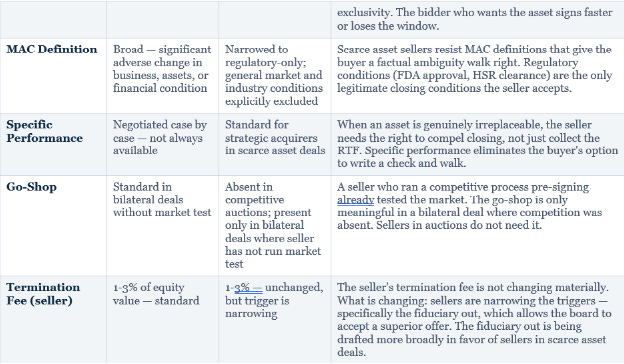
Asset scarcity breaks that balance. When a seller has a late-stage clinical program, an approved product, or a commercial franchise that multiple sophisticated buyers need for competitive reasons — and when there are genuinely few or no comparable alternatives — the seller’s leverage increases on every term simultaneously. The seller can negotiate a higher Reverse Termination Fee (RTF) because the buyer cannot afford to lose the asset to a competing bidder. The seller can narrow the Material Adverse Condition (MAC) because the buyer’s need for the asset is not materially affected by the business conditions that a broad MAC is designed to capture. The seller can insist on specific performance because the asset’s irreplaceability means the RTF alone is not an adequate remedy.
The CLO’s first task in any deal negotiation is to assess where the asset sits on the scarcity spectrum. A Phase 3 readout in a mechanism where three other programs are six months behind is not a scarce asset — the buyer has credible alternatives and will use them as negotiating leverage. A de-risked Phase 3 program in a mechanism where no other company has clinical data, in a therapeutic area where a $50 billion patent cliff is approaching, is a scarce asset — and the deal terms should reflect that reality.
The Six Deal Terms That Scarcity Has Changed
The following table maps the six deal terms most directly affected by asset scarcity — comparing the pre-scarcity standard (2022-2024) with the current standard for genuinely scarce assets in the 2026 market.

The Bidding War Dynamic: What Happens After the Deal Is Announced
A signed merger agreement reveals something the bidder competition did not have during private negotiations: the exact price and all material terms. BioSpace identified this dynamic explicitly in its March 2026 analysis: ‘an announced deal reveals the exact price and terms, giving a party that lost out all the details they didn’t have during private negotiations to top the bid.’ The result is that unsolicited, public bidding wars in biopharma are expected to increase.
The Pfizer/Metsera/Novo Nordisk triangle illustrates the mechanics. Pfizer had a signed agreement. Novo Nordisk’s bid emerged after the announcement. Had Novo ultimately secured the company, the termination fee payable to Pfizer would have been $190 million. The $190 million is not just Pfizer’s consolation prize — it is the structural cost that Novo had to incorporate into its bid economics before deciding whether to move. An acquirer evaluating whether to make a competing bid must pay the original buyer’s termination fee, finance the acquisition at a higher price, and close the process on an even more compressed timeline. The termination fee is a structural barrier to competition, not merely a contractual protection.
The CLO’s role when a competing bid emerges post-announcement: The board must evaluate whether the competing offer is a ‘superior proposal’ under the merger agreement’s fiduciary out provisions. That evaluation requires a careful reading of the superior proposal definition — which is typically specific about the threshold improvement in financial terms required, the certainty of closing required, and the financing condition status required. A competing offer that appears financially superior on headline economics may not satisfy the superior proposal definition if it comes with financing risk, regulatory uncertainty, or a timeline that the board cannot evaluate with confidence. The CLO advising the board in this analysis is doing the most consequential governance work of the entire deal process.
The Seller-Side CLO’s Leverage Assessment Protocol
Before engaging in any merger agreement negotiation, the CLO advising the seller should complete a written leverage assessment. The assessment answers four questions whose answers determine which deal terms the seller can realistically move:
1. How many credible buyers exist for this specific asset?
Not the number of potential acquirers who might theoretically be interested. The number who have the strategic logic, the balance sheet or financing capacity, and the near-term urgency to close a transaction. A cardiometabolic program with Phase 3 data in 2026 might have credible buyer interest from four large-cap pharma companies. A rare disease program with orphan designation in a small indication might have credible buyer interest from two. The number defines the auction’s competitiveness and therefore the seller’s leverage on each term.
2. What is the buyer’s time pressure?
A buyer whose largest product faces LOE in 2028 has different time pressure than a buyer whose pipeline is well-stocked. The LOE timeline creates urgency that the seller can leverage for better terms. A buyer under time pressure accepts shorter exclusivity, higher RTF, and narrower MAC conditions rather than lose the asset to a competitor with the same urgency.
3. Does the asset have a credible IPO alternative?
The IPO market’s strength in H1 2026 — 13 offerings raising $5 billion, topping every full-year total from 2022 through 2025 — means that the dual-track is a genuine alternative for many late-stage biotech companies. A seller who can credibly file an S-1 and has a bank relationship supporting the IPO process has a walk-away option that disciplines the buyer’s terms. A seller who has no realistic IPO path has less leverage on every term and should negotiate accordingly.
4. What is the specific term the seller needs most?
The leverage assessment should produce a prioritized list of terms. The seller who tries to win every negotiating point typically wins fewer of them than the seller who identifies the two or three terms that matter most and trades concessions on the others to get them. For a seller whose primary concern is deal certainty — that the transaction closes — the priority order is specific performance, RTF adequacy, and MAC narrowing. For a seller whose primary concern is value maximization, the priority order is a higher RTF (which improves the seller’s walk-away economics if the buyer withdraws), a broader fiduciary out (which maximizes the seller’s ability to take a competing offer), and a go-shop.
THE BIO-TECHNE/MERCK KGAA PROXY: A CURRENT DATA POINT ON RTF SIZE
The Bio-Techne proxy statement (filed 2026) provides a current reference point on RTF sizing in a large strategic acquisition. The merger agreement in the Merck KGaA / Bio-Techne transaction included a termination fee equal to 2.0% of equity value and a reverse termination fee equal to 10.0% of equity value. The 10% RTF — five times the seller’s termination fee — reflects the Bio-Techne board’s leverage in a transaction where the seller was a highly differentiated life science tools platform with limited direct comparables. For pharma CLOs benchmarking RTF negotiation, the 10% figure is at the high end of current market practice but within the range that sophisticated sellers are extracting for genuinely differentiated assets.
WORKSTREAM 1 IMMEDIATE
Complete the Leverage Assessment Before the First Term Sheet
The leverage assessment is the CLO’s contribution to the seller’s negotiating position before any financial terms are proposed or accepted. The four-question framework above — credible buyer count, buyer time pressure, IPO alternative credibility, and priority term ranking — produces a written document that the CEO, CFO, and investment banker can align on before the first draft term sheet is shared. Without it, the negotiating team is making term-by-term decisions without a strategic framework, which typically produces worse outcomes than a coordinated approach to the two or three terms that matter most. The written leverage assessment also creates a board record of the strategic rationale for accepting specific terms — the same record that a Corwin-cleansed stockholder vote or a post-closing Delaware litigation will examine.
BUSINESS IMPACT: A board that accepted below-market RTF terms because ‘that’s what the banker said was market’ has accepted a worse outcome than it needed to. The CLO who wrote the leverage assessment, put the range of outcomes on paper, and helped the board evaluate which terms were worth trading away created the governance record that protects the decision in retrospect.
WORKSTREAM 2 NEAR-TERM
Build the MAC Definition That Matches the Scarcity Profile
The MAC definition in a merger agreement is a long list of included and excluded conditions. For a scarce asset seller, the negotiation goal is to limit the MAC to events that specifically impair the fundamental value of the asset — not to broad business deterioration that the buyer knew about when it made the offer. The standard exclusions that scarce asset sellers should insist on: general economic and market conditions; conditions affecting the pharmaceutical industry generally; changes in the financial markets or interest rates; changes in law or regulation that apply to the industry generally; acts of God, natural disasters, or geopolitical events; and the announcement of the transaction itself (including any customer or employee reaction to the announcement). What the MAC should cover: a clinical hold by FDA specific to the program; a Complete Response Letter for a pending NDA/BLA; a material adverse finding in the clinical data that was not previously known; or the failure of a material regulatory milestone specifically identified in the merger agreement. A MAC this narrow gives the buyer only a regulatory failure walk right — not a market conditions walk right.
BUSINESS IMPACT: An acquirer who walks from a scarce asset acquisition citing a MAC that the seller’s CLO could have negotiated away is an acquirer who found an exit the seller left open. Every MAC carve-out that the CLO closes is a walk-away option the buyer no longer has.
WORKSTREAM 3 NEAR-TERM
Get Specific Performance Into the Agreement for Every Scarce Asset Deal
For any acquisition where the asset is genuinely irreplaceable — where the seller’s board has concluded that no comparable asset is available at any price — specific performance is the term that converts the RTF from a financial remedy into a genuine closing commitment. The specific performance right is the contractual right to seek a court injunction compelling the buyer to close, rather than electing to pay the RTF and walk. When specific performance is available with no MAC walk right and regulatory-only closing conditions, the buyer cannot exit except through a genuine regulatory failure. The procedure for including specific performance: ensure it is bilateral (both sides can seek it), available immediately upon satisfaction of closing conditions, and not contingent on the seller having waived the RTF as an alternative remedy. The most defensible structure gives the seller the choice between specific performance and the RTF — not one or the other.
BUSINESS IMPACT: The reverse termination fee is the price of walking. Specific performance eliminates the option to walk. For a truly irreplaceable asset, those are different instruments protecting different interests. The seller who accepts the RTF alone has accepted a price on the buyer’s discretion to exit. The seller with specific performance has eliminated that discretion.
For interested practitioners, I have created a Scarce Asset Deal Term Negotiation Protocol and made it available on Gumroad (https://laroccaadvisory.gumroad.com). It contains six sections, designed to be completed in sequence before any deal term is proposed or accepted.
“Asset scarcity has moved from a valuation concept to a deal terms concept. The premium is the number. The MAC definition, the RTF, and specific performance are where the leverage actually lives.”
ABOUT THE AUTHOR
John LaRocca is a pharma and biotech attorney with 26 years of
in-house experience, including CLO/GC tenures at Actavis, Eagle Pharmaceuticals, Aerie Pharmaceuticals, and Y-mAbs Therapeutics. He is the founding partner of LaRocca Advisory Group, a boutique fractional CLO services firm. The GC Playbook reflects his personal views and does not constitute legal advice.
© 2026 The GC Playbook | All rights reserved | Not for redistribution without permission