

Every pharma acquisition is two transactions. The first is what the press release describes: a validated clinical program, a novel mechanism, an established commercial franchise, a talented scientific team. The second is what the integration plan confronts: a manufacturing platform that may not scale, regulatory documentation built for a 50-person company, a CDMO agreement expiring in 18 months, a pharmacovigilance obligation that activates on Day 1, and a set of key employees whose retention bonuses just vested and who’ve been fielding calls from competitors since the deal was announced.
The $527.3 million average deal value prices the first transaction. The second isn’t priced. It’s absorbed. What separates a deal that creates projected returns from one that destroys them is almost always how the second transaction is handled.
THE MODALITY SHIFT COMPOUNDS THE PROBLEM
Biologics now represent 55% of the clinical pipeline, per Pharma Manufacturing’s 2026 industry data. The global biologics manufacturing market was $40.1 billion in 2025 and is projected to reach $140.6 billion by 2033 — driven by ADCs, bispecifics, CGTs, and next-generation monoclonals. These are the modalities driving 2026 deal premiums. They’re also the ones with the most complex manufacturing inheritance obligations, the most unsettled regulatory frameworks, and the sharpest sensitivity to talent departure. A small molecule inheritance problem is typically an SOP integration challenge; a CGT inheritance problem is a multi-year facility qualification commitment.
The Asset-Liability Anatomy: Six Modality Profiles
Six modality profiles follow. Each maps asset against liability with the specificity that an integration plan actually requires.
Profile 1: The Clinical-Stage Small Molecule (Merck/Terns TERN-701 Template)
The Terns acquisition closed May 5, 2026. TERN-701 is now a Merck oncology asset. As a clinical-stage small molecule deal — chemically well-characterized, oral, Phase 1/2 — it carries the lowest manufacturing complexity in this cohort and the highest clinical risk.
WHAT WAS BOUGHT MANAGEABLE POST-CLOSE: WITH WORK | SURFACES: 0–18 months post-close
ASSET: Validated mechanism with early human data; established IP portfolio; oral formulation with predictable bioavailability; small molecule CMC history that FDA has a well-established review framework for; Phase 1/2 clinical organization with active investigator relationships
LIABILITY: Phase 1/2 clinical risk — most Phase 2 oncology assets don’t reach commercial approval; CARDINAL trial continuation — now a Merck program — requires retaining the former Terns team of 50-80 people whose equity vested at the May 5 close; manufacturing process built for trial supply volumes, not commercial scale; CDMO agreements negotiated at small-company pricing — renegotiation at Merck volumes will be required; IP prosecution against Novartis Scemblix requires ongoing active management
The CLO’s inheritance checklist for a clinical-stage small molecule: (1) CDMO contract assignment rights — does the agreement allow assignment to a parent without consent? (2) CRO agreement transfer terms — clinical trial management contracts typically require site notifications and amended consent procedures when the sponsor changes; (3) Principal investigator relationships — identify the 5-10 key investigators whose commitments to the trial are informal and relationship-dependent, not contractual; (4) Competitive patent landscape — commission a freedom-to-operate update addressing the acquirer’s existing portfolio for combination therapy opportunities and potential blocking situations.
Profile 2: The Neuroscience/CNS Phase 2 Program (Lilly/Centessa Template)
The Centessa scheme became effective June 24, 2026 — the High Court sanctioned it on June 22, and Centessa is now a Lilly subsidiary. Neuroscience acquisitions carry a specific risk combination: historically high Phase 2/3 attrition rates, premium valuations driven by large unmet medical needs and limited competition in validated mechanisms, and CVR structures imposing multi-year development obligation covenants.
WHAT WAS BOUGHT MANAGEABLE POST-CLOSE: WITH WORK | SURFACES: 18–48 months post-close (CVR milestones begin)
ASSET: First-in-class OX2R agonist with Phase 2 data in narcolepsy type 1; three-indication CVR opportunity covering NT1, NT2, and IH; portfolio of earlier-stage rare neurological programs; 40.5% premium to 30-day VWAP absorbed into deal model
LIABILITY: UK Scheme of Arrangement — mandatory High Court sanction process; three-milestone CVR requiring Lilly to pursue all three FDA approvals under commercially reasonable efforts standard with full CVR administrative burden; development obligation covenants governing pace of pursuit for each indication; neuroscience manufacturing expertise is a historical gap at Lilly relative to its metabolic disease franchise; no commercial-scale manufacturing platform for a novel CNS mechanism; 19% of total deal value contingent on regulatory outcomes in a therapeutic area with more than 50% Phase 2/3 attrition
The CLO’s inheritance checklist for a CNS Phase 2 program with CVR: (1) Development obligation standard — ‘commercially reasonable efforts’ isn’t defined in the CVR agreement without further specification; negotiate explicit operational commitments — minimum R&D budget, staffing levels, timeline milestones — that define what ‘commercially reasonable’ means for each indication; (2) UK scheme — closed June 24, 2026 after High Court sanction on June 22; Centessa is now a Lilly subsidiary; the transitional services agreement must cover the period from June 24 through full IT and operational integration, which for a company of this size typically runs 12-18 months post-scheme; (3) QPPV appointment — cleminorexton becomes Lilly’s pharmacovigilance obligation at scheme sanction; the QPPV must be in place on Day 1.
Profile 3: The Commercial-Stage Complement/Immunology Platform (Biogen/Apellis Template)
Biogen closed the Apellis acquisition on May 14, 2026 — 82.4% of shares were tendered by the May 13 deadline, and the Section 251(h) back-end merger was completed the same day. Combined 2025 net revenue for Syfovre and Empaveli was $689 million. Commercial-stage acquisitions carry low clinical risk and high operational complexity: the target had revenue, customers, payor relationships, and a field force. All of it transferred on May 14.
WHAT WAS BOUGHT MANAGEABLE POST-CLOSE: WITH WORK | SURFACES: Immediate (Day 1) through 2031 (CVR)
ASSET: Two FDA-approved products — Syfovre for geographic atrophy and Empaveli for PNH and C3G; specialized 350-person commercial field force with rare disease expertise; established specialty pharmacy distribution relationships; Syfovre as the market-leading complement inhibitor for GA; Empaveli for PNH and C3G with Biogen positioning the acquisition as accelerating expansion into nephrology; CVR tied to Syfovre commercial performance benchmarks
LIABILITY: Syfovre/Izervay competitive dynamic — Astellas’s Izervay competes directly in geographic atrophy; CVR payment depends on Syfovre holding commercial dominance against a well-funded competitor; 350-person ophthalmology field force integrating into Biogen’s neuroscience-focused commercial infrastructure; change-in-control provisions in specialty pharmacy contracts, GPO agreements, and payor contracts may require renegotiation consent; SAE reporting obligations for both products activate on Day 1; commercial CVR monitoring runs through 2031
The CLO’s inheritance checklist for a commercial-stage immunology platform: (1) Change-of-control provisions — specialty pharmacy agreements, hub services contracts, GPO agreements, and payor contracts each need review for consent requirements triggered by the acquisition; (2) Field force employment terms — identify the 20-30 senior commercial leaders whose departure would materially affect Syfovre sales execution; (3) CVR net sales tracking — define how Biogen calculates and reports ‘global net sales’ for CVR purposes, including discounts, chargebacks, Medicaid rebates, and patient assistance program costs; (4) Close confirmed — Biogen closed May 14, 2026, well before the September 30 drop-dead date in the merger agreement; Apellis is now a Biogen subsidiary and the CVR administration period has begun.
Profile 4: The ADC Platform (Gilead/Tubulis Template)
ADC acquisitions are among the most manufacturing-complex deals in 2026. The antibody-drug conjugate format requires specialized infrastructure for each component — antibody, payload, linker-drug module, conjugation — and highly specialized analytical chemistry for characterization.
WHAT WAS BOUGHT MANAGEABLE POST-CLOSE: WITH WORK | SURFACES: Immediate through 3–5 years (manufacturing scale-up)
ASSET: Next-generation ADC platform specializing in tumor microenvironment-targeted delivery and dual-payload formats; clinical and preclinical pipeline across multiple oncology targets; proprietary linker chemistry with a differentiated patent position; specialized ADC medicinal chemistry and bioconjugation expertise
LIABILITY: ADC manufacturing demands specialized conjugation facilities, HPAPI handling, and cold-chain logistics; no established commercial-scale ADC manufacturing platform — Gilead must build internal capacity or establish CDMO relationships with specialized providers (Samsung Bioepis, Lonza, AbbVie Contract Manufacturing); as an early-stage company, Tubulis likely has minimal regulatory documentation architecture; FDA’s 2024 ADC guidance imposes specific CMC requirements for conjugation process characterization; technology transfer from laboratory-scale to CDMO-scale is a multi-year commitment; the 20-30 specialized bioconjugation chemists who built the platform are the inheritance — if they leave, the platform leaves
The CLO’s inheritance checklist for an ADC platform: (1) HPAPI handling compliance — any site handling the cytotoxic payload requires OSHA Hazardous Drug compliance and FDA/EMA-compliant containment; confirm inherited CDMO relationships have appropriate HPAPI certifications; (2) Layered IP — ADC IP spans antibody IP, payload/linker IP (frequently licensed from ImmunoGen, Daiichi Sankyo, or ADC Therapeutics), and conjugation process IP; each layer requires freedom-to-operate analysis; (3) Technology transfer obligations — if Tubulis has licensed its manufacturing process to third parties, the acquisition may trigger sub-licensing obligations or consent requirements.
Profile 5: The Cell and Gene Therapy Acquisition
CGT acquisitions have a post-closing complexity profile in a category of their own. The manufacturing is personalized for autologous therapies, highly regulated, expensive to scale, and dependent on specialized facilities and personnel that can’t be easily duplicated. The manufacturing is the inheritance.
WHAT WAS BOUGHT MANAGEABLE POST-CLOSE: WITH WORK | SURFACES: 0–5 years post-close (facility qualification and commercial ramp)
ASSET: Novel therapeutic modality with strong early clinical data; first-mover position in a developing competitive landscape; FDA Breakthrough Therapy or RMAT designation that accelerates the approval pathway
LIABILITY: For autologous therapies: patient-specific manufacturing that can’t be centralized or automated without fundamental process changes; facility qualification taking 18-36 months; vector manufacturing for viral transduction requiring specialized CDMO relationships with very limited global capacity; GMP compliance in a space where regulatory guidance is still being written; reimbursement uncertainty requiring negotiated value-based agreements with payors; long-term follow-up (LTFU) studies required for 15 years post-treatment; Section 232 tariff permanent 0% rate exemption applies to this category
The CLO’s inheritance checklist for a CGT acquisition: (1) LTFU commitments — FDA requires long-term follow-up studies for gene therapy products for up to 15 years; identify every LTFU commitment in existing regulatory submissions and ensure the integration plan maintains them; (2) Vector manufacturing CDMO agreements — global supply of qualified AAV and lentiviral vector manufacturing is severely constrained; if CDMO agreements have change-of-control termination rights, the acquirer faces an immediate manufacturing supply problem; (3) Therapy Access Programs — many CGT companies run compassionate use or patient assistance programs that create contractual access commitments transferring to the acquirer.
Profile 6: The Commercial-Stage Rare Disease Franchise (Collegium/Azstarys Template)
Rare disease and specialty commercial franchise acquisitions integrate faster than clinical-stage deals. An approved product generating revenue isn’t a blank slate — it arrives with specific compliance obligations distinctive to rare disease and controlled substance commercial infrastructure.
WHAT WAS BOUGHT MANAGEABLE POST-CLOSE: YES — with planning | SURFACES: Immediate (Day 1)
ASSET: FDA-approved ADHD product (Azstarys) with established market position; specialty pharmacy and distribution relationships; formulary coverage negotiated with major PBMs; branded commercial infrastructure including patient support programs, copay assistance, and hub services; a revenue stream that’s immediately accretive
LIABILITY: DEA Schedule II controlled substance obligations — DEA registrant transfer requires specific notification and may require a new registration; state-level Schedule II distribution requirements vary by jurisdiction; DSCSA serialization and tracing requirements apply to every unit distributed; commercial payor contracts with change-of-control provisions requiring renegotiation consent; copay assistance program commitments create ongoing cost obligations; PAP administration must continue without interruption through closing; Medicaid and Medicare Part D rebate agreements may require novation
The CLO’s inheritance checklist for a commercial rare disease franchise: (1) DEA registration transfer — initiate immediately post-close; the product can’t ship under Collegium’s registration after closing; (2) State pharmacy board notifications — missed notifications in states requiring prior notification of ownership changes can trigger distribution license suspensions; map every state where Azstarys is distributed and identify applicable deadlines; (3) PBM formulary status — confirm Azstarys’s existing formulary positions survive change of control; losing formulary position in Q1 post-close can’t be remediated quickly.
When Each Liability Surfaces
Organize the inheritance analysis by when each category of liability actually surfaces. Build this timeline before closing and ensure the integration budget has resources for each phase.
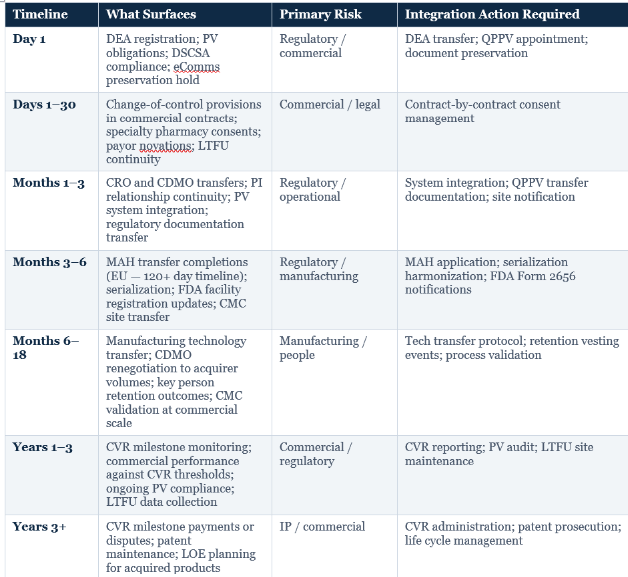
THIS TIMELINE IS A LEGAL FUNCTION OBLIGATION
Every Day 1 item — DEA registration transfer, PV obligation activation, DSCSA compliance, eComms preservation hold — carries immediate regulatory consequences if missed. The CLO who treats integration planning as the project management team’s problem will get the regulatory notice 30 days after close asking why the MAH transfer hasn’t been initiated. Start at signing.
Three Workstreams the Legal Team Owns Through Year 3
Post-close integration has no shortage of workstream owners — project managers, HR, IT, manufacturing quality. The following three belong specifically to the legal function.
WORKSTREAM 1 IMMEDIATE
Build the Integration Legal Workstream Map: Day 1 Through Year 3
The timeline above maps every legally significant post-close obligation from Day 1 through the CVR measurement period. The CLO’s job is to assign ownership, establish monitoring, and ensure adequate resources for each phase. The Day 1 items that can’t be delegated to project management: DEA registration transfer; document preservation hold on all pre-close communications; QPPV confirmation with safety database accessible to the acquirer’s safety team; eComms archiving connected to the acquirer’s review platform; commercial contract change-of-control notification schedule confirmed with BD and commercial operations. Each requires a named legal team member, not a project manager tracking it generally. The regulatory consequences of missing any Day 1 item are immediate and can’t be retroactively cured.
BUSINESS IMPACT: The Day 1 legal failures — missed DEA registration, lapsed QPPV, unreviewed AE reports, missed change-of-control notifications — are the ones that show up in enforcement actions. They’re preventable with planning and specific ownership.
WORKSTREAM 2 NEAR-TERM
Commission the Post-Closing Compliance Audit Within 90 Days
Within the first 90 days post-close, run an independent compliance audit across the gap categories from Issue 9: eComms, CMC documentation, PV system, regulatory documentation architecture, IT regulatory compliance, supply chain tariff exposure, key person risk, and China IP chain of title where applicable. It’s a post-close inventory of what was inherited and what needs remediation before the first FDA inspection. Deliver the audit report to the CLO and chief quality officer with specific remediation items, owners, and timelines. Escalate critical findings to the board. The audit is also the basis for post-close indemnification claims against the seller — which is why it must be completed within the claim notice period specified in the merger agreement.
BUSINESS IMPACT: The first FDA inspection of an acquired facility after a major acquisition tests everything the acquirer inherited. Companies that completed the post-close compliance audit before that inspection face it with a plan. Companies that haven’t face it with surprises.
WORKSTREAM 3 STRATEGIC
Run CVR Administration as a Legal Function, Not a Finance Function
The Biogen/Apellis CVR runs through 2031. The Lilly/Centessa CVR runs through NT2 and IH approval timelines — potentially 2029 or beyond. These are legal instruments with dispute resolution mechanisms that sit in the legal function. Most acquirers assign CVR monitoring to finance or BD as a ‘milestone tracking’ function. The CLO who allows this loses the institutional memory of what was negotiated at signing. When the first milestone is disputed — and it will be, particularly in commercial milestone structures where net sales calculation involves judgment — the company discovers that nobody in the legal function can reconstruct why the definition reads the way it does. The CVR administration program needs a dedicated CVR administrator; annual reporting protocols; a net sales calculation methodology documented and approved by legal; a litigation preparedness plan for the most likely milestone dispute scenarios; and direct communication protocols with the CVR trustee.
BUSINESS IMPACT: A disputed CVR payment at the Biogen/Apellis scale — $2/share on approximately 135 million shares equals approximately $270 million — is a material financial event. The legal architecture for resolving it begins with the CVR agreement text and continues through the administration program that maintains the institutional knowledge to defend or assert the company’s position.
■ CLOSING
The Second Transaction
The announcements get the attention. The CNBC headline, the investor call, the CEO on strategic rationale — that’s the first transaction. The second is quieter. It plays out in the regulatory notifications that must go out, in the pharmacovigilance system that needs reconfiguring, in the manufacturing process that needs transferring, and in the conversations the CLO is having with key people who hold retention agreements and are deciding whether to stay.
The deals that hold up won’t be defined by valuation. They’ll be the ones whose legal teams understood what they were inheriting before the merger agreement was signed — and had the infrastructure in place to manage it from Day 1.
“Every M&A deal is two deals. The first closes on the announced timeline. The second closes over the three years that follow — and its outcome depends entirely on what the legal team did between signing and the first day of integration.”

Know a GC, CLO, or finance leader who’d find this useful? Forward it — genuinely, that’s how The GC Playbook grows.
And if your team has a raise, sale, or audit on the horizon, I take on a few diligence & compliance readiness reviews a year. Just reply to this email.
John (john@laroccaadvisory.com)