

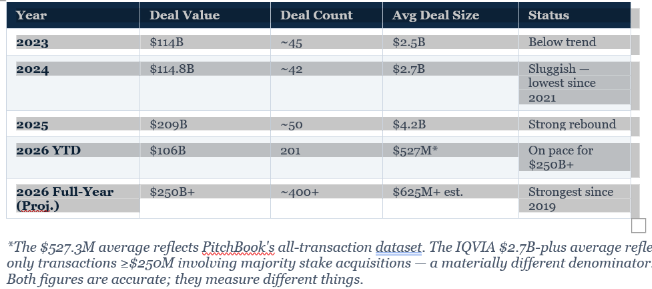
Through the first week of June 2026, biopharma M&A has reached $106 billion across 201 transactions. If the current pace holds, the sector is on track to exceed $250 billion in total deal value for the full year — the strongest performance since the 2019 pre-pandemic peak. HSBC’s head of life sciences equity research summarized it as cleanly as any analyst I’ve read this quarter: pharma companies are ‘buying stuff like it’s going out of fashion.’
I want to take you through what the second half of this year is likely to look like — specifically the deal landscape as it exists today, what the remaining dry powder tells us about deal flow through December, which therapeutic areas are still unsettled and likely to attract the next wave of transactions, and what the macro risks are that could brake this market before it reaches the $250 billion projection. Then I want to identify what this market means for the CLO at a specialty pharma company that is neither Merck nor a biotech founder hoping to get acquired. That is the audience I write for, and the $250B trajectory creates specific obligations for that audience that are not the same as the obligations it creates for the Lilly business development team.
The market tells a story. This issue is the reading of it.
— John LaRocca
Founding Editor | LaRocca Pharma Law Group
The Numbers: Where We Are and What the Pace Means
$106 billion. 201 transactions. Through the first week of June 2026. Those are the PitchBook figures reported by CNBC. To put the pace in context: 2025 finished at $209 billion for the full year. At 2026’s current run rate, the sector reaches $250 billion by late November, with December still to close. The prior record — before the 2019 pre-pandemic peak — was approximately $230 billion.
The IQVIA forecast published in January was $140 billion to $160 billion for full-year 2026, with potential upside of $20 billion to $30 billion in a best-case scenario. The market is running well ahead of that range. What happened between January and June is not mysterious: the Q1 end-of-quarter blitz ($29 billion across seven transactions in 12 days) was followed by a Q2 that has not let up, including Gilead’s acquisition of Tubulis for up to $5 billion — Gilead’s third acquisition since late February alone. The momentum has not stalled.
The Three Engines Driving H2 Deal Flow
Engine 1: The Patent Cliff Has Not Changed Shape
The patent cliff that drove the Q1 blitz is not a Q1 phenomenon. The loss of exclusivity timeline is fixed — Keytruda’s patent clock, Eliquis, Jardiance, Gardasil — and it does not care what quarter a deal closes in. The companies with the largest LOE exposure are simultaneously the companies with the largest remaining acquisition capacity. BMO has identified: Novartis with approximately $53 billion in remaining capacity; AbbVie with approximately $33.6 billion; Bristol Myers Squibb with approximately $21.9 billion; Amgen with approximately $18.6 billion. These four companies alone represent over $127 billion in potential deal capacity. They have not used it all. The H2 deal pipeline is real.
Engine 2: Capital Follows the Science — and the Science Is Producing Winners
The second half of 2026 deal flow will be shaped by which clinical programs produce positive data between now and December. The 2026 FDA approval calendar is dense — and deals frequently close in the 60-180 days following a major positive readout, as the data de-risks the asset and simultaneously increases the seller’s leverage. The therapeutic areas producing the data that is driving deal flow: oncology broadly (ADCs, multispecific antibodies, T-cell engagers, radioligand therapy); metabolic disease and GLP-1 adjacencies; CNS (orexin, Alzheimer’s tau, TDP-43); rare disease; and increasingly radiopharmaceuticals. DIMA Biotechnology’s April-May 2026 deal review specifically identified ADCs, dual-payload ADCs, bispecific ADCs, degrader-antibody conjugates, multispecific antibodies, siRNA, and AI-enabled drug discovery platforms as the modalities commanding premium valuations in the current deal environment.
Engine 3: China-Origin Assets Are Reshaping the Global Deal Landscape
The DIMA April-May 2026 review highlighted a deal environment increasingly defined by China-origin innovation. In 2025, 40% of all assets in-licensed by big pharma had a Chinese licensor — up from 30% in 2024. The aggregate value of China-origin therapeutic deals more than doubled from $45 billion in 2024 to $105 billion in 2025. In H1 2026: Hengrui-BMS $15.2 billion partnership; Innovent-Pfizer $10.5 billion collaboration; CSPC/Jushi Bio-AstraZeneca $420 million upfront. The legal infrastructure implications of China-origin deal flow are substantial and will become more pronounced in H2 as more deals reach the structuring stage.
The Deals to Watch in H2 2026
Several specific situations are likely to define H2’s deal volume. I have identified five that matter most for the legal and strategic intelligence of this newsletter’s audience:
Merck (potential) → Revolution Medicines $28B–$32B est.
Oncology / RAS inhibition | Reported early-stage evaluation by Merck. If executed, would be the largest single pharma acquisition since AbbVie/Allergan ($63B) in 2019. RAS-targeted cancer treatment; large patient population. Legal complexity: enormous. Timeline: unknown.
Gilead → Tubulis Up to $5.0B
ADC oncology platform | Gilead’s third acquisition since late February. ADC platform specializing in dual-payload and tumor microenvironment-targeted delivery. Signals Gilead’s accelerating commitment to oncology platform buildout over traditional antiviral focus.
Multiple bidders (rumored) → Remaining GLP-1 adjacency platforms $2B–$15B range
Metabolic disease / obesity | The orexin race (Lilly/Centessa) opened the playbook for CNS-metabolic crossover acquisitions. Several Phase 2 programs in GLP-1 complementary mechanisms are expected to attract acquirer interest in H2.
PE-backed platforms → Specialty generics and CDMOs $500M–$2B range
Generic pharma / manufacturing | Section 232 tariff environment is restructuring supply chain economics. CDMO platforms with U.S. manufacturing capacity are becoming strategically critical; multiple PE-led transactions expected in H2 as onshoring pressure creates motivated sellers and buyers simultaneously.
Global specialty pharma → Phase 3 rare disease / orphan programs $1B–$5B
Rare disease / orphan drugs | Orphan drug exemption from Section 232 tariffs (0% rate, permanent) creates a structural pricing advantage for U.S.-commercialized rare disease products. Strategic acquirers seeking rare disease platforms benefit from the exemption; deal flow in this segment likely to accelerate in H2 specifically because of the tariff architecture.
THE MACRO RISK: WHAT COULD BRAKE THIS MARKET
Three macro risks could slow H2 deal flow from the $250B+ trajectory. First, interest rate deterioration: CNBC noted that dealmaking momentum has continued ‘despite an interest rate environment that has deteriorated following inflationary pressures.’ If rates increase materially from current levels, large cash-funded deals become comparatively more expensive and some debt-financed PE deals become unworkable. Second, FDA approval calendar disruptions: if major assets in the deal pipeline receive Complete Response Letters or clinical setbacks in H2, the de-risking dynamic that drives post-readout acquisitions reverses sharply. Third, MFN pricing agreement renegotiations: the Section 232 MFN pricing commitments that the 13 Annex II companies made to achieve 0% tariff rates could, if interpreted broadly, create revenue pressure that reduces the financial capacity for acquisitions at the margin.
What This Market Means for the CLO Who Is Not at a Top-Ten Pharma Company
The $250 billion trajectory is a story about Merck, Lilly, Biogen, and Novartis. It is also a story about the specialty pharma company whose board is asking: ‘Are we a buyer, a seller, or a bystander?’ That is the question the CLO at a PE-backed specialty pharma company, a commercial-stage biotech, or a mid-cap branded pharma needs to answer. This market’s characteristics make that question more consequential than usual.
If You Might Be a Seller:
The premium environment — average deal value up 44% to $527.3 million — makes 2026 an unusually favorable time to explore a strategic process. But premium valuations require premium preparation. The CLO’s job is to ensure the company’s data room, regulatory posture, IP chain of title, and compliance program can withstand intensive diligence from a sophisticated acquirer who has completed 14 transactions at $500M+ in a single quarter. The companies that get acquired at premium prices in this market are the ones that can pass diligence without surprises. The ones that cannot get repriced or walked away from.
If You Might Be a Buyer:
In a market where Novartis has $53 billion in remaining capacity and AbbVie has $33.6 billion, a mid-cap specialty pharma company is not competing for the same targets. The targets available to companies with $500 million to $2 billion in acquisition capacity are the earlier-stage assets, the non-auction processes, and the strategic fits that larger acquirers overlook because the deal is not large enough to move their needle. The CLO’s job in a buying environment is to ensure that the company’s M&A infrastructure: its HSR readiness, diligence playbooks, board approval process, outside counsel relationships can execute as quickly as a large pharma deal team even when the company does not have the same resources. Speed and certainty of close are the mid-market acquirer’s primary competitive advantages in any auction.
If You Are a Bystander:
There is no such thing as a bystander in a $250 billion M&A market. If you are not acquiring, you are being evaluated as an acquisition target by someone who is. The CLO who has not conducted a mock sell-side diligence in the last 18 months does not know what an acquirer would find. That is not a comfortable position in this market.
WORKSTREAM 1 IMMEDIATE
Build or Update the Company’s M&A Position Paper: Buyer, Seller, or Both?
The $250 billion deal environment creates an obligation for every CLO at a specialty pharma company to have a documented position on the company’s M&A strategy even if that strategy is to be acquired, to acquire, or to do nothing and maintain optionality. The position paper should address: (1) The company’s LOE exposure over the next 5 years and whether acquisitions are necessary to fill that gap; (2) The company’s current balance sheet capacity for acquisitions and how that compares to the competitive landscape; (3) The specific therapeutic areas where the company has competitive advantages as an acquirer and where it would be outbid by larger players; (4) The sell-side readiness assessment — what an acquirer would find in diligence and what remediation the company should complete before a process begins; (5) A preliminary valuation range for the company based on current market multiples and the $527.3M average deal value. This document is not a strategic plan it is a legal and governance instrument that ensures the board has been adequately advised on the company’s position in the market.
BUSINESS IMPACT: A CLO who has not briefed the board on the company’s position in a $250 billion M&A market has not fulfilled their governance obligation. The board meeting that happens after an unsolicited approach is not the right time to have this conversation for the first time.
WORKSTREAM 2 NEAR-TERM
Update Your Valuation Benchmarks: The $365M Average Is Gone
The $527.3 million average deal value in 2026 represents a 44% increase from the $365 million average in 2025. If your company is using 2025 transaction multiples in its internal valuation models for M&A target assessment, for sell-side preparation, for board presentations on strategic alternatives, those models are materially understating the current market. The update should include: current EV/Revenue and EV/EBITDA multiples by therapeutic area based on 2026 transactions; current premium-to-VWAP data (Biogen paid 86% premium to 90-day VWAP for Apellis); CVR prevalence and its impact on headline vs. effective deal value; and the emerging pattern of $1B-$10B bolt-on transactions as the preferred acquirer structure. The CLO who participates in the valuation update rather than leaving it entirely to the CFO and bankers ensures that the legal structure options (CVR, milestone payments, earnouts) are incorporated into the valuation analysis from the beginning.
BUSINESS IMPACT: Valuation models based on 2025 data produce analysis that systematically undervalues current M&A opportunities by 30-45% and overstates the affordability of acquisition targets. Both errors produce bad strategic decisions.
WORKSTREAM 3 STRATEGIC
Therapeutic Area Prioritization: Map Your Products Against the Deal Landscape
The 2026 deal landscape is not uniformly active across all therapeutic areas. ADCs, multispecifics, orexin/CNS, rare disease, GLP-1 adjacencies, and radiopharmaceuticals are commanding premium valuations and attracting multiple bidders. Specialty generics, mature branded products without meaningful patent runway, and traditional small molecule platforms in competitive categories are not receiving the same premium treatment. The CLO of a company with products in multiple categories needs to understand this landscape for two reasons: it determines which assets would command premium valuations in a strategic transaction, and it identifies which assets in the company’s pipeline are most likely to attract inbound acquisition interest. The mapping exercise is a collaboration between legal, business development, and medical affairs but the CLO should own the framework that connects the product strategy to the legal and governance implications of different deal scenarios.
BUSINESS IMPACT: A company that does not know which of its assets would attract premium valuations in the current market cannot make informed decisions about licensing, spin-outs, or full company sale alternatives. Therapeutic area market intelligence is a legal strategy prerequisite.
“The $250 billion M&A trajectory is not a number to monitor. It is a mandate to act — whether as buyer, seller, or the company that decided with full information that it was not going to do either.”
ABOUT THE AUTHOR
John LaRocca is a pharma and biotech attorney with 26 years of in-house experience, including CLO/GC tenures at Actavis, Eagle Pharmaceuticals, Aerie Pharmaceuticals, and Y-mAbs Therapeutics. He is the founding partner of LaRocca Advisory Group, a boutique fractional CLO services firm. The GC Playbook reflects his personal views and does not constitute legal advice.
© 2026 The GC Playbook | All rights reserved | Not for redistribution without permission
Know a GC, CLO, or finance leader who’d find this useful? Forward it — genuinely, that’s how The GC Playbook grows.
And if your team has a raise, sale, or audit on the horizon, I take on a few diligence & compliance readiness reviews a year. Just reply to this email.
John (john@laroccaadvisory.com)