

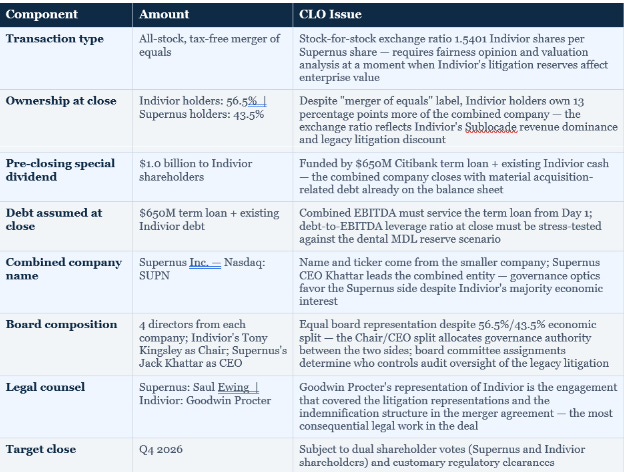
On August 1, 2026, Supernus Pharmaceuticals and Indivior Pharmaceuticals signed a definitive agreement to combine in an all-stock, tax-free merger of equals. The combined company will be named Supernus, Inc., trade as SUPN, and carry a pro forma revenue base of approximately $2.2 billion anchored by Indivior’s Sublocade — buprenorphine extended-release for opioid use disorder — alongside Supernus’s Qelbree for ADHD, ZURZUVAE for postpartum depression, and GOCOVRI and ONAPGO for Parkinson’s disease. Jack Khattar, Supernus’s CEO, leads the combined company. The deal is expected to close in the fourth quarter of 2026.
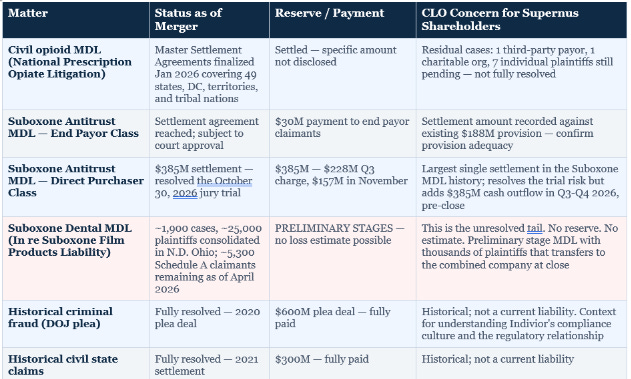
The trade press covered this as a CNS powerhouse story. The correct analytical frame is different. Before this merger closes, Indivior will declare a $1 billion special cash dividend to its existing shareholders, financed partly by a $650 million term loan from Citibank. The combined company closes with that debt already on its balance sheet. And while the Master Settlement Agreements covering Indivior’s civil opioid MDL obligations were finalized in January 2026, the Suboxone dental MDL — approximately 1,900 cases representing roughly 25,000 plaintiffs consolidated in the Northern District of Ohio — remains in its preliminary stages, with no reserve established and no loss estimate possible. That litigation transfers to the combined company at closing.
Supernus shareholders will own 43.5% of a combined company that carries $650 million of acquisition-related debt and an unquantified dental MDL exposure. The merger agreement’s representation about the status of the dental MDL, and the indemnification structure Supernus’s counsel at Saul Ewing negotiated around it, is the document that determines whether the 43.5% stake was priced correctly.
“Merger of equals” is a transaction description, not a legal conclusion. The CLO’s job is to identify where the equality ends.
— John LaRocca
Founding Editor | LaRocca Advisory Group
The Deal Structure
The transaction is structured as a forward triangular merger — Indivior’s wholly-owned subsidiary merges into Supernus, with Supernus surviving as a wholly-owned subsidiary of Indivior, which then changes its name to Supernus, Inc. The surviving legal entity on the Indivior side is the combined Supernus, Inc. For purposes of the litigation analysis, the entity that survives and carries the combined company’s obligations is the successor to Indivior’s existing legal relationships — including the litigation described below.
The Litigation Profile: What Transfers at Closing
The ‘merger of equals’ label requires context against Indivior’s litigation history. Indivior has been one of the most extensively litigated pharmaceutical companies in the U.S. over the past decade, with cumulative settlements and criminal penalties exceeding $1.3 billion. Most of that history is resolved. The portion that is not resolved is the piece that belongs in the merger agreement’s representation and warranty analysis.
The Dental MDL: The Unquantified Tail
The Suboxone Film Products Liability MDL — the dental litigation — is the unresolved item. As of April 28, 2026, approximately 1,900 cases representing approximately 25,000 plaintiffs were consolidated in multi-district litigation in the Northern District of Ohio. A tolling agreement was negotiated for Schedule A plaintiffs, permitting plaintiffs’ counsel additional time to investigate whether any Indivior product was used before determining whether to file individual complaints. As of April 28, 2026, the Schedule A claimants had been reduced to approximately 5,300. The MDL cases are in their preliminary stages. No estimate of possible loss can be made. No reserve has been established specific to this litigation.
The dental MDL theory: the plaintiffs allege that Suboxone Film — the sublingual buprenorphine/naloxone formulation that Indivior marketed as a safer alternative to Suboxone tablets in part because the film formulation reduced the risk of accidental pediatric exposure — caused dental decay, tooth loss, and other oral health complications. The theory is that prolonged sublingual dissolution of the film’s acidic components caused damage to tooth enamel. Indivior disputes the causal connection and has contested the litigation at every stage.
The litigation is in its earliest substantive phase — the fact sheet process is still producing case dismissals on one end, while the tolling agreement is preserving additional claims on the other. There is no date certain for trial, no bellwether schedule, and no settlement negotiation framework in the public record. For merger purposes: the combined company inherits this litigation in full, with no reserve, no estimate, and no trial date.
The Pre-Closing Dividend and the Leverage Question
The $1 billion pre-closing special dividend is the financial feature of this deal that deserves the most attention. Indivior will fund the dividend from a $650 million term loan from Citibank and the remainder from existing cash on the balance sheet. The term loan is drawn before close. The combined company begins its post-close operating life with $650 million of acquisition-related debt plus Indivior’s existing balance sheet obligations.
The financial logic: Indivior shareholders, who will own 56.5% of the combined company post-close, receive $1 billion in cash before the deal closes — capturing value that would otherwise be locked in equity they would need to sell after close. This is a standard technique in all-stock mergers where one party has more cash on its balance sheet than the exchange ratio captures. The CLO concern is not the dividend itself — it is the combined leverage profile against the combined EBITDA in a scenario where the dental MDL produces material reserve requirements in the near term.
The $125 million in projected cost synergies are the offset: if synergies materialize on schedule, the combined company’s EBITDA capacity to service the term loan is adequate. If the dental MDL reserve obligation competes with debt service for cash in the same period, the leverage profile tightens materially.
The Representation and Warranty Analysis
The most consequential legal work in this deal was the merger agreement’s representation structure around the dental MDL. The standard litigation representation requires that the company has disclosed all pending and threatened legal proceedings material to the business, that the reserve and accrual for such proceedings is adequate under GAAP, and that no material adverse effect will result from the resolution of disclosed proceedings. For a litigation with no reserve and no loss estimate, the representation must be carefully drafted to avoid an unintended warranty that the absence of a reserve reflects an assessment of immateriality.
The Indivior 10-Q states plainly: “Given the status and preliminary stage of litigation, no estimate of possible loss can be made at this time.” That language appears in the public filing. The merger agreement representation must be consistent with that disclosure — representing that the dental MDL is in preliminary stages, that no reserve has been established because a loss estimate cannot be made at this stage, and that the merger agreement disclosure schedule identifies the MDL accurately. A broader representation that the disclosed litigation reserves are adequate would be affirmatively inaccurate.
Goodwin Procter, as Indivior’s merger counsel, drafted the representation. Saul Ewing, as Supernus’s merger counsel, negotiated the scope. The article a CLO should actually read is the merger agreement’s disclosure schedule for the dental MDL — which is not public — not the press release description of the deal.
The Governance Asymmetry
The deal has an interesting governance structure that does not obviously reflect the 56.5%/43.5% economic split. Four directors from each company join the combined board. Indivior’s Tony Kingsley becomes board chair. Supernus’s Jack Khattar becomes CEO. Supernus’s Rockville, Maryland headquarters becomes the combined company’s global headquarters. The combined company uses Supernus’s name and Supernus’s Nasdaq ticker.
This structure reflects the reality of the transaction: Indivior wanted the diversification out of OUD-only exposure and used the merger to accomplish it, but the resulting company is operationally led by the Supernus team. Kingsley as board chair with Khattar as CEO creates a split that gives Indivior’s legacy shareholders governance representation at the board level without operational control. The audit committee composition — which will oversee the dental MDL reserve determination and the OUD revenue trajectory — is the governance appointment that matters most and has not been publicly announced.
WORKSTREAM 1 IMMEDIATE
Analyze the Dental MDL Representation in the Merger Agreement Before Endorsing the Deal
For any CLO advising on an acquisition where the target carries an unresolved MDL in preliminary stages with no reserve and no loss estimate, the merger agreement representation structure around that litigation is the highest-priority legal workstream. Specifically: does the representation characterize the litigation accurately as preliminary stage with no current reserve, or does it represent more broadly that disclosed litigation reserves are adequate? The latter would be inaccurate. Does the disclosure schedule identify the dental MDL with sufficient specificity — case count, plaintiff count, tolling agreement status, current posture in the MDL court — to satisfy the buyer’s due diligence obligation? Is there a specific indemnification carve-out for dental MDL losses exceeding a defined threshold? Is there a material adverse effect qualifier for the dental MDL that is specific enough to give the buyer a walk right if the MDL posture materially worsens before close? These are the questions that Saul Ewing’s representation of Supernus was built to answer. For any CLO in a comparable position — acquiring a company with an unresolved MDL in preliminary stages — these are the four specific provisions to negotiate.
BUSINESS IMPACT: A merger agreement that closes without specific protection around an unquantified MDL gives the buyer shareholders an undisclosed risk at the moment they vote on the transaction. A well-structured representation and indemnification package creates clarity. The Supernus shareholders voting on this deal deserve both.
WORKSTREAM 2 NEAR-TERM
Assess the Combined Leverage Profile Against the Dental MDL Reserve Scenario
Before any analyst presentation of the combined company’s financial profile, model the leverage scenario in which the dental MDL produces a material reserve requirement in the same period as the $650M term loan requires service. The combined company’s $2.2 billion pro forma revenue base and the $125 million synergy projection provide the numerator. The $650M term loan debt service provides one denominator element. The dental MDL reserve — which could range from immaterial to several hundred million dollars depending on the plaintiffs’ causation case — is the variable that stress-tests the leverage profile. This is the financial scenario that the audit committee of the combined company will be managing from Day 1 of close. The CLO who modeled it in advance is the CLO who owns the right conversation with the board.
BUSINESS IMPACT: A leveraged combined company with an unquantified MDL reserve obligation is not a crisis. It is a capital allocation management challenge. The CLO who mapped it is the CLO who can manage it.
WORKSTREAM 3 STRATEGIC
Map the Audit Committee Oversight Structure for the Dental MDL Post-Close
The audit committee of the combined Supernus, Inc. will be responsible for the periodic assessm
ent of the dental MDL reserve and the decision of when and at what level to establish a reserve against a litigation that currently has no estimate. That decision — when to establish a reserve, at what level, and what disclosure obligation attaches to the establishment of a material reserve — is a governance function with direct securities law consequences. The CLO’s strategic workstream is confirming that the audit committee’s composition includes at least one member with experience overseeing pharmaceutical litigation reserves, that the audit committee’s access to outside MDL counsel is direct and not filtered through management, and that the board-level disclosure protocol for any material change in the dental MDL’s posture is clearly defined before the first post-close board meeting. The audit committee that makes the reserve determination for the dental MDL is making one of the most consequential financial judgments the combined company’s board will face in its first 12 months.
BUSINESS IMPACT: Audit committee governance over pharmaceutical litigation reserves is the governance workstream that most CLOs do not focus on until the reserve decision creates a disclosure obligation. The combined Supernus board has the opportunity to build the governance structure before that decision arrives.
“Merger of equals is a transaction description. The dental MDL is the legal reality. The CLO’s job is to map the gap between the two before the shareholders vote.”
I’ve created a Merger of Equals Legal Architecture Protocol. You can find it at: https://laroccaadvisory.gumroad.com/

ABOUT THE AUTHOR
John LaRocca is a pharma and biotech attorney with 26 years of in-house experience, including CLO/GC tenures at Actavis, Eagle Pharmaceuticals, Aerie Pharmaceuticals, and Y-mAbs Therapeutics. He is the founding partner of LaRocca Advisory Group, a boutique fractional CLO services firm. The GC Playbook reflects his personal views and does not constitute legal advice.