FROM THE EDITOR
The PwC mid-year analysis stated the current PE investment thesis in pharma with unusual directness: ‘private equity seeks durability in specialty pharma and life sciences services.’ Not pipeline upside. Not Phase 3 binary bets. Durability. The analysis identified the scarce resource in the current market as differentiated assets with near-term commercial potential — and PE is specifically not competing for those assets against large-cap strategic pharma. PE is buying the assets that generate durable revenue while those strategic buyers fight over the next clinical blockbuster.
The durability thesis is a specific answer to a specific market condition. In 2024 and 2025, PE funds chased pipeline assets alongside strategic buyers — bidding on Phase 2 programs at valuations that reflected speculative clinical upside. That strategy produced inconsistent returns when Phase 3 data was negative and an increasingly competitive acquisition process when data was positive. The durability play is structurally different: acquire a commercial-stage specialty pharma company or a pharma services platform with established revenue, known margins, and identifiable moats — then exit to a strategic buyer who wants the revenue or the infrastructure.
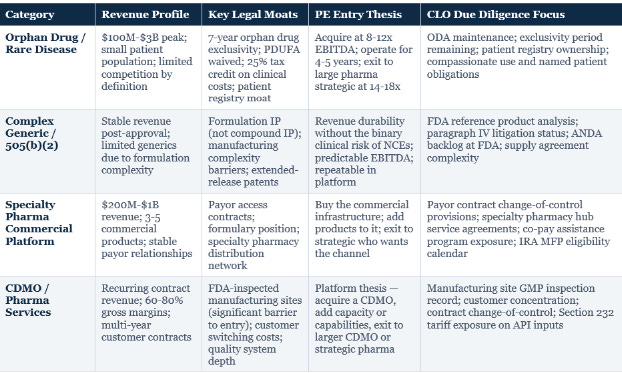
Bain’s 2026 Global Healthcare Private Equity report identified four categories of durable pharma assets attracting PE capital: orphan and rare disease commercial franchises, complex generic and 505(b)(2) specialty products, commercial-stage specialty pharma platforms, and CDMO/pharma services businesses. Each has a distinct legal architecture, a distinct set of diligence risks, and a distinct exit pathway.
The durability play changes what the CLO owns. The legal work at a pipeline acquisition is about clinical program risk, IP chain of title, and CVR design. The legal work at a durability acquisition is about commercial contract durability, IRA MFP exposure, payor access architecture, and the exit conditions that make the strategic sale attractive.
— John LaRocca
Founding Editor | LaRocca Advisory Group
What ‘Durability’ Means as an Investment Thesis
In PE underwriting, a durable asset is one whose revenue can be projected with reasonable confidence over the investment horizon without depending on binary clinical outcomes. A pipeline asset’s NPV depends on whether the drug works. A durable commercial asset’s NPV depends on whether patients keep buying the drug that already works, whether payors keep covering it, and whether the competitive landscape remains favorable.
Durability does not mean zero risk. It means quantifiable risk that the PE sponsor can underwrite at deal entry — and that produces a more predictable return profile than the binary outcomes of clinical-stage investing. The Bain analysis confirmed this: ‘specialty pharmaceuticals, neurology, nephrology, and plastic surgery are areas where greater scale offers the most durability for PE investment. Pharma services investments have long benefited from consistent demand.’ The durability thesis is specifically the inverse of the speculative market cap thesis covered in this newsletter’s September analysis — rather than buying future value at a probability discount, PE is buying current value at an EBITDA multiple.
The legal risk profile of a durability acquisition is specific. The pipeline acquisition requires clinical program diligence, regulatory transfer analysis, CVR design, and FDA relationship assessment. The durability acquisition requires commercial contract durability analysis, IRA MFP exposure modeling, payor access architecture review, change-of-control risk mapping across all commercial relationships, and the Section 232 tariff exposure assessment for any product with API import exposure. These are not the same diligence workstreams, and the CLO who applies pipeline diligence protocols to a durability acquisition is missing the things that matter most.
The IRA’s Impact on the Durability Thesis
The IRA’s Maximum Fair Price program directly affects the durability thesis for three of the four categories — orphan/rare disease, 505(b)(2) specialty, and commercial platforms. The fourth category (CDMO/pharma services) is not affected by MFP because CDMOs are not Medicare Part D products.
Orphan Drug and the MFP Carve-Out
Orphan drugs with an indication covering fewer than 200,000 patients are exempt from MFP selection under the IRA’s small population carve-out. This is one of the most significant structural advantages of the orphan drug durability thesis: the seven-year orphan exclusivity, the pricing power, and the patient registry moat persist without the MFP compression that applies to large-population drugs. The PE fund acquiring a rare disease commercial franchise with orphan designation and MFP exemption is acquiring a revenue stream that is structurally protected from the IRA’s most direct pricing mechanism. For drugs with multiple orphan indications, each indication’s status must be analyzed separately — a drug with an orphan indication in one population and a non-orphan indication in a second population may face MFP selection on the non-orphan indication even while the orphan indication remains exempt.
505(b)(2) and Complex Generic — the Small Molecule Pill Penalty
The IRA’s nine-year eligibility clock for small molecules (versus thirteen years for biologics) hits 505(b)(2) specialty products with the same force it hits NCEs. A 505(b)(2) product approved in 2018 reached IRA selection eligibility in 2025. If the product has significant Medicare Part D volume, it is a candidate for negotiation in the next selection cohort. The PE underwriting model for a 505(b)(2) specialty pharma acquisition must incorporate MFP ceiling pricing at each age tier — 75% of non-federal AMP at year nine, 65% at year twelve, 40% at year sixteen. A 505(b)(2) product with $300 million in Medicare Part D revenue at year fourteen of commercial life, subject to the 35% MFP ceiling discount, faces a revenue reduction of $105 million annually. That reduction must be in the EBITDA model before LOI.
Commercial Platform — Payor Contract Durability Under MFP
A commercial specialty pharma platform’s payor access architecture — the formulary placements, prior authorization criteria, and specialty pharmacy contracts that determine patient access to the product — has historically been the most durable element of the commercial franchise. A product in a preferred formulary position with established payor relationships and a specialty pharmacy hub network has a commercial moat that takes years for a competitor to displace. The IRA complicates this durability thesis in a specific way: the MFP creates a Medicare reference price that payors and PBMs use as a benchmark in commercial negotiations even for non-Medicare patients. A product whose Medicare price drops 40% under MFP may face commercial pricing pressure from payors who cite the MFP as evidence that the product can be priced lower across the book of business. The CLO’s payor contract audit must assess which agreements include MFP reference pricing provisions and what their commercial implications are.
Section 232 in the Durability Thesis
The Section 232 pharmaceutical tariff adds a cost-of-goods dimension to the durability acquisition that did not exist before April 2026. A commercial-stage specialty pharma company with API sourced from a non-exempt country is carrying ongoing tariff exposure that compounds against its EBITDA margin. The specific categories to assess:
• HTSUS classification of all API and key starting materials: Is the API classifiable under a specialty product exemption (orphan, CGT, ADC, plasma-derived, nuclear medicine)? If yes, the 0% rate may apply with proper documentation.
• API sourcing geography: API sourced from a non-exempt country with existing most-favored-nation pricing agreements may qualify for the reduced rate under the tariff’s MFN onshoring carve-out. Document the basis for any reduced rate claimed.
• Cost of goods model: The floating rate mechanism means the tariff is applied so the total cumulative duty rate equals 100% — not the Section 232 rate added on top. Confirm the cost of goods model applies the correct calculation before closing.
• CDMO agreement tariff passthrough provisions: Does the manufacturing agreement specify who bears the tariff cost on API procured by the CDMO on the company’s behalf? This is the most commonly overlooked contractual gap in specialty pharma commercial operations.
The Exit to Strategic Buyer: What Makes the Durability Play Attractive at Year 4-5
The PE durability thesis depends on a strategic buyer acquiring the platform or product at a meaningful EBITDA multiple premium over the entry price. The exit multiple arbitrage — buying at 8-12x and selling at 14-18x — is the financial architecture of the trade. What makes the strategic buyer pay that premium:
• Commercial infrastructure scarcity: A specialty pharma commercial platform with established payor relationships, specialty pharmacy contracts, and a patient services hub is exactly the commercial infrastructure that a mid-market specialty pharma company or a large pharma company seeking a new commercial channel cannot build from scratch in the relevant therapeutic area.
• Orphan drug franchise completeness: A rare disease commercial franchise with multiple orphan designations, a patient registry, and a global named patient program is significantly more difficult to replicate than it is to acquire. The strategic buyer pays a premium for the registry moat and the regulatory exclusivity stack.
• CDMO capacity constraints: In the current post-Section 232 environment, FDA-inspected U.S. manufacturing capacity is genuinely scarce. A CDMO with U.S.-based API or formulation capacity commands strategic premiums from pharma companies seeking to reduce their Section 232 tariff exposure or reduce their supply chain concentration risk.
The CLO’s role in the exit preparation: The exit-ready legal file for a durability acquisition has the same five elements as any PE portfolio company exit — IP chain of title, commercial contract change-of-control audit, regulatory compliance file, litigation log, and equity documentation. But the durability acquisition adds two elements that the pipeline acquisition does not: the MFP exposure analysis with a current eligibility calendar for every product, and the payor access architecture documentation showing the transferability of the commercial relationships that justified the premium.
WORKSTREAM 1 IMMEDIATE
Build the MFP Eligibility Calendar Into the Durability Acquisition Model Before LOI
The MFP eligibility calendar is the most critical piece of financial analysis in a durability acquisition and the one most commonly absent from the preliminary deal model. Before any letter of intent is executed on a commercial-stage specialty pharma acquisition: build the MFP eligibility calendar for every marketed product; calculate the ceiling price at each age tier for each product with significant Medicare Part D volume; model the revenue impact at the point of MFP effectuation; and confirm whether any product qualifies for the orphan drug MFP exemption. For a product within five years of MFP eligibility, the revenue impact should be incorporated into the acquisition EBITDA multiple — not treated as a risk factor with a probability discount. The MFP is a scheduled event, not a contingency. The deal model that treats it as a contingency is a deal model built on inaccurate assumptions.
BUSINESS IMPACT: A durability acquisition closed without an MFP eligibility calendar is a durability acquisition whose most significant revenue risk is not in the model. The PE sponsor whose board approved the acquisition without that analysis owns the gap at Year 3 when the first MFP selection affects the portfolio company’s commercial operations.
WORKSTREAM 2 NEAR-TERM
Audit the Commercial Contract Architecture for Durability and Change-of-Control Risk
The commercial contract architecture at a specialty pharma platform is what makes the durability thesis real. The payor contracts, the specialty pharmacy hub agreements, the co-pay assistance program, the patient support program, and the group purchasing organization relationships are the infrastructure that keeps revenue flowing. Each of these relationships has a change-of-control provision, a term and renewal structure, and a notice and consent requirement that the PE acquisition will trigger. The commercial contract audit — conducted before closing and integrated into the transition planning process — identifies which relationships require counterparty consent, which require notice only, and which auto-renew under their existing terms. A commercial platform whose three largest payor contracts all have change-of-control termination rights is a platform whose commercial durability has a closing-date cliff. Identify it before closing, not after.
BUSINESS IMPACT: The payor relationships that took years to build at the right formulary tier do not automatically transfer to a new owner on closing day. The CLO who mapped the change-of-control provisions before closing has a remediation plan. The one who discovers them post-close is managing a commercial disruption that the investment thesis did not contemplate.
WORKSTREAM 3 STRATEGIC
Structure the Exit Documentation Package 18 Months Before the Target Exit Date
The exit documentation package for a durability acquisition has two elements beyond the standard PE portfolio company exit file. First, the MFP exposure analysis with a current eligibility calendar: the strategic buyer acquiring a commercial specialty pharma platform in Year 4-5 of a PE hold will request the MFP exposure analysis as a standard diligence item. Have it prepared and updated annually rather than assembled in response to the data room request. Second, the payor access architecture documentation: a structured description of each significant payor relationship, the formulary position, the prior authorization criteria, the contract term and renewal status, and the historical revenue contribution. This documentation is what the strategic buyer uses to evaluate the commercial durability that justified the acquisition premium in the first place. The strategic buyer paying 14-18x EBITDA for a specialty pharma platform is paying for the commercial infrastructure as much as the products on it. That infrastructure needs to be documented in a way that a diligence team can evaluate in three weeks.
BUSINESS IMPACT: The strategic buyer who does not understand the durability of the commercial platform at the point of exclusivity grant reprices the acquisition. The PE sponsor who built the documentation package before the exit process began negotiated from a position of demonstrated value, not asserted value.
For interested practitioners, I have created a Durability Acquisition Protocol and made it available on Gumroad (https://laroccaadvisory.gumroad.com). It contains five sections covering the specific diligence dimensions that standard pipeline acquisition protocols miss.
“Private equity is not competing for the next clinical blockbuster. It is buying the revenue that already exists, the commercial infrastructure that is genuinely scarce, and the regulatory moat that protects both. The durability thesis is the most disciplined trade in the current pharma market.”