

THE GC PLAYBOOK
Pharma M&A Intelligence for Legal Leaders Who Execute the Deals
Issue No. 4 | April 2026
DEAL DISSECTION: Q1 2026’s $15.6B M&A Blitz
theGCplaybook.com
FROM THE EDITOR
Seven transactions. Twelve days. Twenty-nine billion dollars. In the last two weeks of March 2026, the biopharma M&A market produced a concentrated burst of dealmaking that Jefferies described as a return to “normalcy” — which is a remarkable word to use about a week in which Merck, Eli Lilly, and Biogen each announced billion-dollar acquisitions in rapid succession. This issue is a deal dissection of that blitz, and I want to take you beyond the deal headlines to the mechanics, the psychology, and the legal architecture underneath them.
I have spent decades in rooms where these decisions are made. I have been on the buy side and the sell side. I have watched term sheets expire on December 31st because the financing commitment had a year-end drop-dead, and I have watched boards rush approvals because a competing bidder surfaced in week eleven of a twelve-week exclusivity period. When seven transactions close in the last twelve days of a quarter, that is not a coincidence. It is a window into how legal and business development teams are managing board approval cycles, fiscal year incentives, and financing commitment expirations simultaneously. That is what this issue is about.
I will walk through each of the seven deals, extract the legal and strategic architecture from the public record, and then draw out the four themes I think define what this wave tells us about the biopharma M&A market as we move into Q2 2026 and beyond.
The deals are the news. The mechanics are the education. Let’s get into it.
— John LaRocca
Founding Editor | LaRocca Pharma Law Group
■ DEAL DISSECTION
Q1 2026’s $15.6B M&A Blitz: What Seven Deals in Twelve Days Tells Us About Biopharma’s Dealmaking Psychology
Quarter: Q1 2026 | Total deal value (Q1): $15.6B across 19 deals (JP Morgan / DealForma; upfront equity at announcement, excluding contingent payments) | End-of-quarter sprint: 7 deals, ~$29B total potential consideration, in final 12 days
Setting the Stage: Why Q1 2026 Mattered
The biopharma M&A landscape entering 2026 carried significant momentum from a Q4 2025 resurgence. After sluggish dealmaking in 2024 — the lowest level of M&A activity since 2021 — aggregate deal value in 2025 more than doubled year-over-year, reaching $133 billion for the full year. That was the second-highest figure in five years. The setup for 2026 was therefore not a slow recovery but rather a market with dry powder already in motion, acquirers with board mandates to deploy capital, and a set of structural forces that had been building for months.
Three structural forces deserve specific identification because they are what drove the timing of what happened in March, not just the fact of it.
Force 1: The Patent Cliff Is Real and Getting Closer
Over $230 billion in biopharma revenue faces loss of exclusivity by 2030. Keytruda — still the world’s best-selling cancer drug — is on the clock. Gardasil, Eliquis, Jardiance — are all also facing IP cliffs within the planning horizon. For any major pharma company whose pipeline does not independently cover that revenue gap, the only strategic alternatives are internal R&D acceleration or external acquisition. Given that internal R&D timelines are measured in decades, the latter is not optional. It is the plan. Every major pharma BD team going into Q1 2026 had targets in their pipeline review that they had been evaluating for six to eighteen months. The question was not whether to buy — it was when and at what price.
Force 2: The Biotech Valuation Setup Was Right
The XBI — the ETF tracking U.S. biotech companies — was up 64% over the preceding year entering Q1 2026. Six biopharma IPOs raised $1.8 billion in Q1 alone, already surpassing full-year 2025 IPO proceeds. Valuations had recovered enough that sellers were willing to transact, but had not recovered so far that acquirers faced prohibitive premiums. The window of aligned seller/buyer valuation expectations was open. These windows close. The legal and BD teams at major pharma know this from experience, and they accelerated timelines to transact while the alignment held.
Force 3: The Macro Uncertainty Clock
Q1 2026 was also the quarter in which the Section 232 pharmaceutical tariff regime took shape — culminating in the April 2, 2026 proclamation issued just days after quarter-end — MFN pricing pressure was building, and the regulatory and trade policy environment was generating the kind of strategic uncertainty that historically compresses deal activity. Experienced BD teams close deals before the certainty window closes, not after. Multiple acquirers told investors in their Q1 earnings calls that the spate of transactions reflected a deliberate effort to complete deals before the macro environment potentially deteriorated further.
THE QUARTER-END TIMING PHENOMENON
The concentration of deal announcements in the final 12 days of Q1 is not accidental — it is the predictable output of a specific set of legal and financial mechanics. Board approval deadlines cluster around quarter-end because audit committees and compensation committees typically meet in the weeks before quarterly earnings disclosure periods. Financing commitment letters have economic terms that expire — interest rate locks, bridge commitment fees, underwriting commitments — and those expirations are typically negotiated to run through quarter-end or fiscal year-end. HSR pre-merger notification periods create predictable closing timelines that lawyers calculate backwards from their target announcement date. When all three of these forces align, deals that were in advanced negotiation for 60-120 days get signed in the same two-week window. That is exactly what happened in late March 2026.
The Seven Deals: An Anatomy
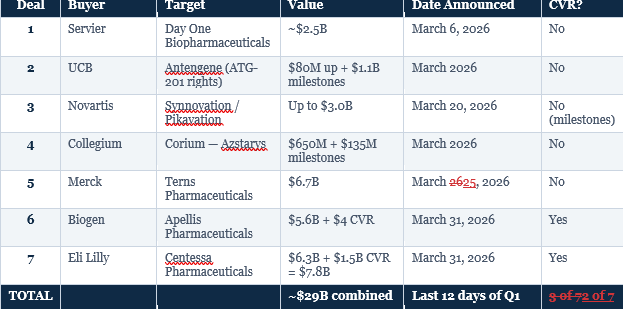
Here is the complete deal summary for the late-March blitz. I will go deeper on the three largest transactions — Merck/Terns, Lilly/Centessa, and Biogen/Apellis — because they carry the most instructive legal and strategic architecture. The four smaller transactions illuminate different strategic patterns worth understanding
.The Three Anchors: The $5B+ Transactions
DEAL 5 — THE BLOCKBUSTER BID March 25, 2026
Merck → Terns Pharmaceuticals
$6.7 billion | CML / Leukemia
KEY ASSET: TERN-701, an oral BCR-ABL inhibitor targeting next-generation CML therapy. Designed to overcome asciminib resistance — the primary remaining unmet need in chronic myelogenous leukemia following the Gleevec era.
CLO LENS: No CVR in this structure, which is notable given the asset’s clinical stage. BMO commented that “Terns shareholders may have left some upside on the metaphorical table” — the all-cash structure with no CVR suggests Merck had high conviction in the asset and was unwilling to share the upside. From a sell-side legal perspective, the absence of a CVR is the tell. When a buyer refuses to include a CVR, they are either highly confident in the asset or concerned about the operational complexity of administering milestone payments. At a $6.7B all-cash price, it is conviction.
DEAL 6 — THE COMPLEMENT PIVOT March 31, 2026 — Final day of Q1
Biogen → Apellis Pharmaceuticals
$5.6B ($41/share) + up to $4 CVR/share | Immunology / Complement / Rare Disease
KEY ASSET: Syfovre (pegcetacoplan, intravitreal) for geographic atrophy — the leading complement inhibitor for an AMD-related indication. Empaveli (systemic pegcetacoplan) for PNH and C3G. A specialized 350-person commercial field force acquires with the company.
CLO LENS: This is Biogen’s first major transaction of 2026 and its most significant diversification from neuroscience. The $41/share price represents an 86% premium to the 90-day VWAP and a 35% premium to the 52-week high — aggressive pricing that signals competitive tension in the process. The CVR structure is uniquely calibrated to commercial execution rather than clinical risk: $2/share if Syfovre global net sales reach $1.5B in any year from 2027-2030, and an additional $2/share if sales reach $2.0B in any year 2027-2030, with 2031 as a fallback for the second tier if neither threshold is met in 2027-2030. This is a rare CVR design that bets on commercial performance of an already-approved drug, not regulatory approval of a pipeline asset. The primary competitor risk — Astellas’ Izervay in geographic atrophy — is the central variable the CVR sellers are being asked to accept.
DEAL 7 — THE NEUROSCIENCE BET March 31, 2026 — Final day of Q1
Eli Lilly → Centessa Pharmaceuticals
$6.3B upfront + $1.5B CVR = $7.8B total | Neuroscience / Sleep / Narcolepsy
KEY ASSET: Lead asset: cleminorexton (formerly ORX750), a once-daily oral OX2R agonist with Phase 2a data across narcolepsy type 1, narcolepsy type 2, and idiopathic hypersomnia. Centessa’s broader portfolio includes additional OX2R agonists (ORX142, ORX489) for neurological, neurodegenerative, and neuropsychiatric indications. Lilly’s third Q1 2026 deal alongside Ventyx (oral inflammation) and Orna (in vivo cell therapy), and announced concurrently with a $2.75B expansion of its Insilico Medicine partnership.
CLO LENS: The $1.5B CVR hinges on FDA approval of the orexin agonist — a Phase 2 asset in a notoriously difficult therapeutic area. BMO suspected Lilly included the CVR “to deflect risk in the difficult neuro sector.” This is correct as a structural read: when a buyer attaches a CVR to a clinical-stage neuroscience asset, they are buying optionality and insisting that the seller’s shareholders bear the approval risk alongside them. The size of the CVR relative to the upfront — roughly 19% of total consideration — is at the larger end of what sellers typically accept, which suggests either competitive pressure in the auction or Centessa’s board judging that FDA risk on an OX2R program was genuinely material.
The Four Supporting Players: Different Strategic Patterns
DEAL 1 — THE FRENCH ADVANCE March 6, 2026
Servier → Day One Biopharmaceuticals
~$2.5 billion | Oncology / Pediatric Rare Cancer
KEY ASSET: Tovorafenib (Ojemda) — FDA-approved RAF inhibitor for relapsed or refractory pediatric low-grade glioma harboring BRAF alterations (the most common form of childhood brain tumor). Also two clinical-stage ADCs targeting B7-H4 and PTK7.
CLO LENS: Servier acquiring Day One is the story of a European independent pharma company buying U.S. commercial infrastructure it cannot build organically. Tovorafenib is already approved and generating revenue — this is a commercial acquisition, not a pipeline bet. The legal architecture is straightforward: clean reps on a commercial-stage marketed product, a go-forward compliance program for a newly acquired commercial infrastructure, and the interesting cross-border regulatory dimension of a French company operating an FDA-approved oncology drug in the U.S. market.
DEAL 2 — THE AUTOIMMUNE BRIDGE March 2026
UCB → Antengene (ATG-201 rights)
$80M upfront + up to $1.1B milestones | Autoimmune / B-Cell Disorders
KEY ASSET: ATG-201 — a CD19/CD3 bispecific T-cell engager targeting B-cell related autoimmune diseases. Phase 1 trials. China-based Antengene brings manufacturing and early-stage clinical data.
CLO LENS: UCB’s deal with Shanghai-based Antengene is the clearest example in this cohort of the China-origin asset sourcing trend that JP Morgan’s Q1 report flagged as a defining pattern. China now contributes approximately 30% of the global biotech pipeline. The licensing structure here — worldwide rights with an $80M upfront, not an acquisition — reflects the legal complexity of China-origin asset deals: IP ownership documentation across CNIPA and USPTO, FDA’s increasing scrutiny of manufacturing sites subject to geopolitical risk, and the export control considerations that arise when a Chinese biotech transfers commercial rights globally. Any legal team working this deal was managing a multi-jurisdictional IP chain of title review that BigLaw-only coverage cannot do efficiently.
DEAL 3 — THE PRECISION ONCOLOGY BOLT-ON March 20, 2026
Novartis → Synnovation / Pikavation
Up to $3.0 billion | Precision Oncology / PI3Kα
KEY ASSET: SNV4818 — a mutant-selective PI3Kα inhibitor in Phase I/II trials, targeting oncogenic PI3Kα mutations in solid tumors. The selective inhibitor profile is designed to improve on the tolerability limitations of earlier PI3K inhibitors.
CLO LENS: Novartis acquiring a PI3Kα platform is strategic pipeline stacking aimed squarely at HR+/HER2- breast cancer (~40% of which carry PIK3CA mutations), with potential extension to other solid tumors. The structure is $2B upfront plus up to $1B in development, regulatory, and commercial milestone payments to Synnovation as the seller — note this is a milestone-bearing private-LLC acquisition, not a CVR (CVRs are securities issued to public-target shareholders, with separate trustee, dispute-resolution, and disclosure mechanics). The key legal diligence question on a mutant-selective kinase program: IP exclusivity around the selectivity mechanism, which is the differentiated scientific claim that justifies the premium valuation over a generic PI3K inhibitor.
DEAL 4 — THE COMMERCIAL TUCK-IN March 2026
Collegium → Corium — Azstarys ADHD
$650M + up to $135M milestones | ADHD / CNS
KEY ASSET: Azstarys (serdexmethylphenidate/d-methylphenidate) — an FDA-approved ADHD medication. Adds to Collegium’s existing pain and ADHD portfolio.
CLO LENS: Collegium acquiring Azstarys from Corium is the most structurally straightforward deal in this cohort: commercial-stage marketed product, clean FDA approval history, no late-stage clinical risk. The milestone payments are almost certainly keyed to Azstarys revenue thresholds — commercial milestones rather than approval milestones. The CLO’s focus in a deal like this is squarely on the commercial compliance program: Schedule II controlled substance compliance infrastructure, DEA registration transfers, state pharmacy board notifications, and the Copay assistance and specialty pharmacy agreements that Azstarys currently operates under.
■ THE FOUR THEMES
What This Blitz Actually Tells Us: Four Themes With Legal Implications
Reporting that seven deals closed in twelve days is the news. Understanding why those seven deals, why those twelve days, and what the structural patterns mean for legal teams is the analysis. Here are the four themes I pulled from this cohort.
Theme 1: The CVR Is Now a Standard Deal Architecture Feature — And It Has Legal Complexity That Most CLOs Underestimate
Two of the seven deals in this cohort included a true contingent value right (Lilly/Centessa and Biogen/Apellis); a third (Novartis/Synnovation) used economically similar milestone payments to a private-LLC seller, which differ from a CVR in legal and accounting architecture but reflect the same valuation logic. BMO noted that three of the last five major biopharma acquisitions before this report included a CVR. That is not a coincidence — it reflects a market-wide response to a specific valuation problem: how do you close a deal on a clinical-stage asset when buyer and seller have materially different views of probability of approval?
The CVR is the financial answer. But it creates a legal instrument that requires ongoing administration for years after the transaction closes. Every CLO or GC involved in a deal with a CVR structure should understand the following:
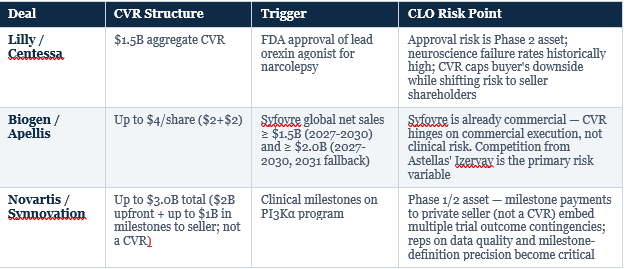
The CVR agreement is not an afterthought — it is a separate legal instrument with its own trustee, its own dispute resolution mechanism, and its own milestone definitions that become the subject of litigation if the milestone is close but not met, or if the parties disagree about how net sales were calculated. The Lilly/Centessa CVR is keyed to an FDA approval that will be evaluated by the FDA, not by Lilly — but how the development program is managed between signing and approval will be governed by the merger agreement’s covenants. Those covenants are where the real legal negotiation happens on a CVR deal.
If you are the acquiring company’s CLO and you are reviewing a CVR deal: read the milestone definitions with the same intensity you bring to the indemnification article. You will thank yourself later.
Theme 2: The Quarter-End Timing Effect Is Real, and Legal Teams Should Plan Around It — Not Just Accommodate It
I want to make the quarter-end timing phenomenon concrete, because it is something legal teams experience as pressure without always naming it as a structural feature they can anticipate and manage.
When a major pharma company’s board approves an acquisition, the approval timeline is typically governed by three clocks running simultaneously:
• The financial commitment clock: Bridge financing commitments and debt underwriting commitments carry interest rate lock-ins and commitment fees with expiration dates. A bank that commits to provide $5B in bridge financing at a specific rate does not do so indefinitely. These commitments routinely expire at quarter-end or calendar year-end. A deal that misses the commitment expiration has to go back to market for financing — at potentially different terms. This clock is invisible to outside observers but is the dominant driver of deal signing urgency inside the legal team.
• The board approval cycle: Audit committees meet before earnings season. Compensation committees review executive equity agreements before quarter-end. The governance infrastructure of large public pharma companies — and the audit committee chair’s schedule — creates natural slots for board M&A approvals in the final two weeks of each quarter. March 31 is the most concentrated slot in the calendar year.
• The Q1 earnings disclosure clock: Deals announced before quarter-end appear in Q1 earnings calls. Deals announced after April 1 appear in Q2 earnings calls. For a CEO whose analyst community has been expecting M&A deployment, there is a material reputational and market expectations benefit to showing completed deal activity in Q1 reporting. This is not a legal reason to rush a deal — but it is a real force that accelerates internal decision timelines.
“When three of these clocks converge in the same two-week window, the legal team’s job is not just to close the deal fast — it is to close it right while moving fast. Those are not the same thing, and the tension between them is where legal risk accumulates.”
Theme 3: China-Origin Assets Are a Structural Feature of the Deal Market — And They Create Legal Complexity That Must Be Resourced Specifically
The UCB/Antengene licensing deal is the most visible China-origin transaction in this cohort, but it is representative of a broader pattern. JP Morgan’s Q1 2026 deal report specifically identified China-origin asset sourcing as one of the defining trends shaping Q1 biopharma licensing and M&A activity. China now contributes approximately 30% of the global biotech pipeline, and its companies are increasingly participating in high-value alliances and M&A activity as assets matured in Chinese clinical programs become attractive to Western acquirers.
This creates a specific legal complexity bundle that is different from standard biopharma M&A due diligence:
• IP chain of title across Chinese and U.S. patent systems: CNIPA filings, PCT applications, assignment history, and the specific question of whether employment agreements at the originating Chinese institution properly conveyed IP rights to the company selling the asset. This is a different due diligence skill set from USPTO analysis.
• Manufacturing site regulatory risk: FDA’s 483 inspection track record for Chinese manufacturing facilities, CDER import alerts, and the geopolitical dimension of relying on Chinese CMOs for a drug the acquirer intends to commercialize in the U.S. market. Section 232 tariff exposure (see Issue 2 of this newsletter) adds a layer of supply chain cost analysis to what used to be a purely regulatory diligence question.
• Export control considerations: The transfer of biological material, data, and manufacturing know-how from a Chinese biotech to a U.S. or European acquirer can implicate Chinese export control regulations — a framework that has expanded significantly since 2022 and that most Western pharma legal teams do not have in-house expertise to navigate.
• Committee on Foreign Investment (CFIUS) considerations: For acquisitions (as opposed to licensing deals), CFIUS jurisdiction over investments in U.S. biotech companies by Chinese investors or acquirers runs in both directions. A U.S. acquirer of a Chinese biotech should assess whether the transaction structure raises CFIUS concerns if the Chinese company has U.S. operations or U.S. clinical trial participants.
The practical implication: any legal team working a China-origin asset deal needs either in-house expertise in Chinese IP law and regulatory frameworks, or outside counsel with a dedicated China practice — not just a general pharma transactional team.
Theme 4: The Therapeutic Breadth Is a Signal About Acquirer Strategy, Not a Coincidence
The seven deals in this cohort span: CML/leukemia (Merck/Terns), narcolepsy/sleep disorders (Lilly/Centessa), geographic atrophy/PNH/rare disease (Biogen/Apellis), pediatric brain tumors (Servier/Day One), B-cell autoimmune disease (UCB/Antengene), PI3Kα/solid tumors (Novartis/Synnovation), and ADHD (Collegium/Corium). That is seven therapeutic areas across six acquirers.
This breadth is not random. It reflects two converging dynamics that practitioners and analysts have flagged in commentary on Q1: DLA Piper’s Mike Patrone described “immense” competition for “the real big products and compelling technologies and pipelines,” and Jefferies analysts noted that investors are operating with a “shorter-term horizon” pursuing “higher-conviction catalysts.” When every major pharma company is simultaneously looking to fill pipeline gaps, the deal market becomes a competition for the best available assets in any therapeutic area — not a sequential filling of specific therapeutic slots.
The legal implication of therapeutic breadth is primarily a due diligence specialization problem. A legal team that was conducting diligence on Centessa in neuroscience one week and evaluating an ADC platform the next week needs either a very broad in-house capability or a highly disciplined triage system for which diligence workstreams require therapeutic-area-specific expertise versus which can be generalized. The CLO who knows their team’s capability gaps — and fills them with the right outside counsel for each deal type — runs a faster and more accurate diligence process than the CLO who tries to cover everything with generalists.
The Market Is Moving. Is Your Legal Function?
Seven deals in twelve days is a data point. What those seven deals represent — the structural convergence of patent cliff urgency, aligned valuations, financing commitment expirations, and board approval cycles — is a pattern. Patterns repeat. Q4 2025 had a surge. Q1 2026 had a surge. The Jefferies analysts who called this a return to “normalcy” were saying, essentially, that the market has found its rhythm. That means the legal teams at biopharma companies need to have found their rhythm too.
The in-house legal function at a specialty pharma company is never more valuable than when a deal is being executed under time pressure in a competitive market. It is also never more exposed — because time pressure is how compliance mistakes get made, how diligence gaps get papered over, and how CVR provisions get drafted sloppily at 2 AM. The CLOs who will navigate this market well are the ones who have done the preparation between deals: the CVR playbook, the China diligence protocol, the sell-side mock audit, the board approval process, the pre-positioned outside counsel relationships.
The preparation is the job. The deal is the test.
“The seven deals that closed in the last twelve days of Q1 were not built in twelve days. They were built in the sixty to one hundred twenty days before that — in the preparation, the internal approvals, the financing commitments, and the diligence that preceded the announcement. The legal team’s work happens before the headline.”


■ WORKSTREAMS FOR THE IN-HOUSE DEAL TEAM
Five Workstreams: What This Wave Demands of Your Legal Function
The Q1 2026 deal wave is not just background market context — it creates specific obligations and opportunities for in-house legal teams. Here are the five workstreams I would be running if I were the CLO at a specialty pharma company watching this market.
