

FROM THE EDITOR
On April 2, 2026 — exactly one year after Liberation Day — President Trump signed a proclamation imposing Section 232 tariffs on patented pharmaceuticals and their active pharmaceutical ingredients. The headline number is 100%. The real story is more complicated, and in this issue I want to take you through exactly what was signed, what it actually means for different parts of the industry, and what your legal function needs to be doing about it right now.
I want to start with a premise that gets lost in the political noise around tariffs: Section 232 is not trade policy. It is national security policy. That distinction matters enormously for how this action will hold up legally, how durable it is likely to be, and what leverage pharmaceutical companies have in challenging or negotiating around it. The Trade Expansion Act of 1962 gives the President extraordinarily broad authority once a Commerce Department investigation returns an affirmative national security finding — and this one did, after a year-long investigation that began April 1, 2025.
The steel and aluminum tariffs that Trump imposed in his first term under the same statutory authority survived legal challenge and were not fully revoked by the Biden administration. That history matters. These tariffs may be here for a while.
But the framework is also more nuanced than the headlines suggest. There is a tiered rate structure, a set of negotiated carve-outs for companies that have already made deals with the administration, country-specific rates for allied trading partners, and — critically — a complete exclusion for generic pharmaceuticals and biosimilars at this time, with a mandatory one-year review of whether that exclusion should be extended or narrowed. That last element is the one I will be watching most closely.
Let me take you through the anatomy of the proclamation, the rate structure, and then the six workstreams I think every CLO in this industry should be running before the first effective date hits on July 31.
— John LaRocca
Founding Editor | LaRocca Pharma Law Group
REGULATORY READ
The 100% Tariff That Is Not Really 100%: A Practitioner’s Guide to the Section 232 Pharmaceutical Proclamation
Authority: Section 232 of the Trade Expansion Act of 1962, 19 U.S.C. § 1862
Proclamation Date: April 2, 2026 Investigation Initiated: April 1, 2025
First Effective Date: July 31, 2026 (Annex III companies) General Effective Date: September 29, 2026
Why Section 232? The Legal Architecture of This Action
The administration’s choice of Section 232 as the vehicle for pharmaceutical tariffs is deliberate and strategically significant. The International Emergency Economic Powers Act — the authority used for the February 2026 tariff wave — was legally contested and ultimately constrained by court challenges. Section 232 is a different animal.
Under 19 U.S.C. § 1862, the President may impose tariffs or other import restrictions on any article and its derivatives that the Secretary of Commerce finds are being imported into the United States in quantities or under circumstances that threaten to impair national security. Once Commerce makes an affirmative finding, the President’s authority to act is extraordinarily broad and courts have historically been deferential.
The Commerce Department initiated its investigation on April 1, 2025, and transmitted its final report — which has not been made public — to the President in early 2026. The proclamation summarizes the finding: imports of patented pharmaceuticals and associated APIs are being imported in quantities and under circumstances that threaten U.S. national security. The data cited in support: as of 2025, approximately 53% of patented pharmaceutical products distributed in the United States were produced abroad, and an extraordinary 85% of patented APIs by volume were sourced from foreign manufacturers.
Those numbers explain why this policy is structurally durable in ways that IEEPA tariffs are not. The national security finding gives the administration a legal foundation that has withstood challenge for steel and aluminum for nearly a decade. Pharmaceutical companies should plan for these tariffs to be in place — in some form — for years.
What is actually covered — the two-part test. Coverage is not simply ‘all patented drugs.’ A product is a ‘patented pharmaceutical article’ subject to the tariff only if it simultaneously (a) is subject to a valid, unexpired U.S. patent AND (b) is listed in the FDA’s Orange Book (Approved Drug Products with Therapeutic Equivalence Evaluations) for small molecules, or the Purple Book (Lists of Licensed Biological Products) for biologics. A patented drug not in either book, and a drug whose patent has expired regardless of listing, falls outside scope. This two-part test is the starting point for every product classification exercise.
The Rate Structure: Five Distinct Buckets, Not One
The 100% headline number applies to companies that have not made deals with the administration and do not qualify for country-of-origin exceptions. But the proclamation establishes five distinct tariff treatment categories. Every company in the pharmaceutical supply chain needs to know which bucket it is in.
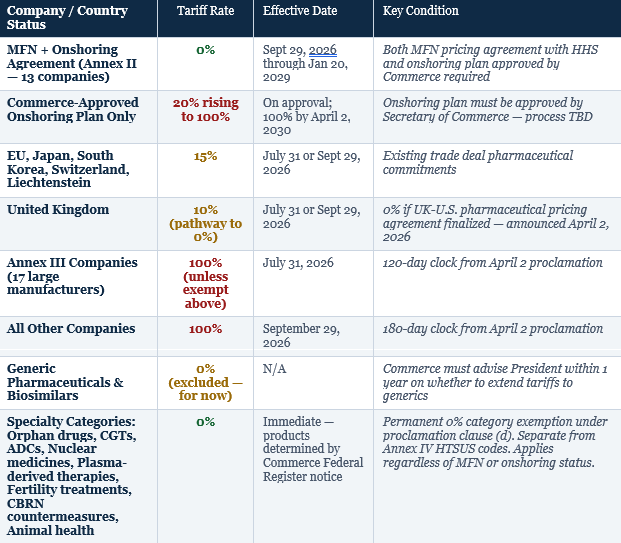
THE FLOATING RATE MECHANISM: NOT AN ADD-ON
The Section 232 tariff operates as a floating, cumulative rate — not an absolute additional duty stacked on top of existing tariffs. Where a covered product is already subject to an existing non-duty-free MFN tariff rate, the Section 232 duty is reduced so that the total cumulative rate equals 100%. If the applicable existing MFN rate already exceeds 100%, only the existing rate applies. The correct exposure calculation for any product is not ‘current tariff + 100%’ but ‘what additional duty brings the cumulative rate to 100%.’ Every HTSUS classification exercise must model this mechanism before quantifying actual cost impact.
THE KEY INSIGHT ON THE RATE STRUCTURE
The proclamation is structured as a behavioral incentive framework, not a traditional punitive tariff. The administration’s explicit goal is to compel two things simultaneously: onshoring of pharmaceutical manufacturing to the United States, and Most Favored Nation pricing concessions on branded drugs sold in the U.S. market. Companies that do both get a 0% rate. Companies that do neither face a 100% rate. The tariff is the lever; the deals are the destination. Every corporate strategy decision in response to this proclamation should begin with the question: what is our negotiating position on MFN pricing, and what are we willing to commit to on onshoring?
The Generics and Biosimilars Exclusion: The Most Important Sentence in the Proclamation
Section 11 of the proclamation states: “I have further determined not to adjust imports of generic pharmaceuticals and their associated ingredients, including biosimilar products, at this time.” That phrase — “at this time” — is the most consequential clause in the entire document for the generic pharmaceutical industry.
The proclamation simultaneously directs the Secretary of Commerce, within one year of the proclamation date — meaning by approximately April 2027 — to advise the President on whether circumstances indicate a need to extend Section 232 tariffs to generic pharmaceuticals and their associated ingredients. The administration has built in a mandatory review of the exclusion. It is not permanent.
This has two immediate implications. First, generic and biosimilar companies are not affected today, but they cannot treat the current exclusion as a stable long-term planning assumption. Second, Commerce is now conducting an ongoing analysis of the generic pharmaceutical import supply chain — the same kind of investigation that produced the affirmative national security finding on branded pharmaceuticals. The data on generic API sourcing is even more alarming from a national security framing perspective than branded API: India and China account for the dominant share of generic API supply globally, and the administration is acutely aware of this.
I will be watching the April 2027 Commerce report date as carefully as any regulatory event this year. Generic company CLOs should have it on their calendars today.
The MFN Pricing Agreement: What It Actually Requires
The 0% tariff pathway — the outcome every large branded pharmaceutical manufacturer wants — requires two agreements with the U.S. government: an onshoring plan approved by the Secretary of Commerce, and a Most Favored Nation pharmaceutical pricing agreement with the Department of Health and Human Services.
The MFN pricing framework requires participating companies to offer U.S. patients drug prices no higher than the lowest price charged for the same drug in any comparable developed country. This is a significant commercial concession. MFN pricing, if broadly implemented, would substantially compress U.S. branded drug revenues — which are currently the global cross-subsidy that funds pharmaceutical R&D for the rest of the world. The administration acknowledges this explicitly in its fact sheet: the policy is designed to shift the burden of R&D funding from American patients to other developed markets.
PhRMA’s response was unambiguous: “Tariffs on cutting-edge medicines will increase costs and could jeopardize billions in U.S. investments announced in the last year. Every dollar spent on tariffs is a dollar that can’t be invested in communities across the country.” The MFN pricing concession is the deeper threat to the industry’s business model than the tariff itself — because it restructures the global pricing architecture that has sustained pharmaceutical innovation for four decades.
Thirteen companies had already executed MFN agreements with the administration prior to the April 2 proclamation and are listed in Annex II as exempt. These companies negotiated under pressure — the tariff threat was the explicit leverage — and their agreements serve as the template for what the administration expects from others.
The UK Pharmaceutical Agreement: A Preview of the Deal Structure
The most concrete window into what an MFN deal looks like comes from the U.S.-U.K. pharmaceutical pricing agreement, announced in principle on December 1, 2025 and ratified on April 2, 2026. Under that agreement, UK pharmaceutical products enter the U.S. tariff-free through at least January 19, 2029, provided that all major UK pharmaceutical companies enter into the MFN and Tariff Agreements negotiated with HHS and Commerce.
The structure is instructive: it is a country-level framework agreement within which individual companies make company-specific commitments. The EU, Japan, South Korea, Switzerland, and Liechtenstein are at a 15% rate consistent with pharmaceutical trade commitments in existing bilateral deals, with a pathway to lower rates if those countries execute comparable pharmaceutical pricing frameworks.
The tariff, in other words, is functioning exactly as designed — as a forcing mechanism for bilateral pharmaceutical pricing negotiations that the administration has been unable to conclude through traditional diplomatic channels.
“The 100% tariff is the threat. The MFN pricing agreement is the deal the administration actually wants. Understanding that distinction is the beginning of every corporate strategy conversation about this policy.”
■ STAKEHOLDER IMPACT
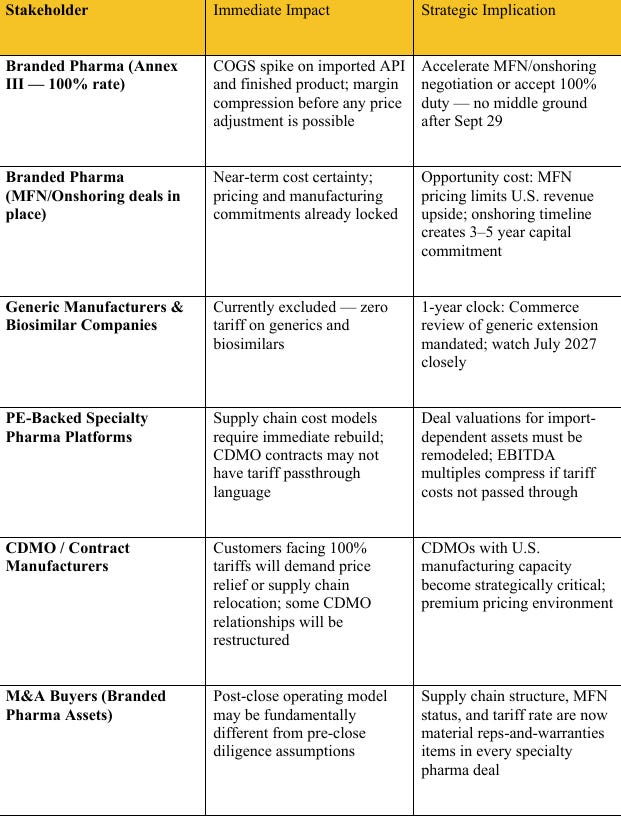
Who Gets Hit, Who Gets Cover, and Who Should Be Worried
Before working through the legal workstreams, let me frame the business impact by stakeholder. The Section 232 proclamation lands very differently depending on where you sit in the pharmaceutical supply chain.
■ THE WORKSTREAMS
