

FROM THE EDITOR
Sixteen court losses in three years. Every constitutional argument — takings, First Amendment, due process — rejected by every court that has considered them. The IRA’s Medicare drug price negotiation program took effect on January 1, 2026. The litigation is finished as a constitutional matter. The CLO who spent the last three years in litigation support mode has a different job now.
I want to be precise about what ‘the litigation is over’ means and what it does not. AbbVie is still litigating statutory claims — the argument that CMS exceeded its authority in specific implementation decisions. A Supreme Court cert petition remains possible in the Court’s October 2026 term. The program is not immunized from all future legal challenge. What is over is the constitutional campaign: the argument that conditioning Medicare participation on accepting a negotiated Maximum Fair Price violates the Takings Clause, the First Amendment, or Due Process. Courts have rejected that argument sixteen times. It will not succeed.
The operational reality of that outcome: Maximum Fair Prices are the commercial floor for every Medicare Part D and, from 2028, Part B product that gets selected for negotiation. Round 1 prices were live January 1. Round 2 — 15 drugs including semaglutide at a 71% discount — becomes effective January 2027. From 2029, 20 drugs per year are added. The program will cover approximately 60 drugs by 2030. That is not a future risk to model with a probability discount. For any product approaching the eligibility threshold, it is a scheduled event to plan for.
The CLO’s role has shifted from asking whether the program survives to asking how the company operates within it. That shift requires a different set of tools.
— John LaRocca
Founding Editor | LaRocca Advisory Group
The IRA Litigation Is Over. What the CLO Does Now.
Format: Regulatory Read | Covers: MFP program anatomy, the pill penalty, litigation status, M&A diligence implications, life cycle management, CLO workstreams
What the Program Actually Does: The Numbers That Drive the Analysis
The Maximum Fair Price program has four moving parts that the CLO needs to understand precisely, because each one affects a different function the legal team advises.
The Eligibility Clock
Small molecule drugs become eligible for CMS selection seven years after FDA approval. Biologics become eligible eleven years after FDA licensure. MFPs take effect roughly two years after selection — meaning the operational impact lands at approximately nine years post-approval for small molecules and thirteen years for biologics. The four-year gap between the two timelines is the ‘pill penalty’ that has become the most consequential structural feature of the IRA for development strategy. A University of Chicago policy analysis estimated that the 9-to-13 disparity will result in 188 fewer small molecule medicines reaching market. Venture funding in small molecule programs has fallen 70% since the IRA was introduced in 2021.
Trump Executive Order 14273, issued April 15, 2025, directed HHS to work with Congress to equalize the timelines. The EPIC Act (H.R. 1492) would align both to eleven years. Neither has passed. Until the legislative fix clears, the pill penalty is operational reality — and every development-stage decision about whether to pursue a small molecule or biologic approach for a given target carries this differential as a pricing variable in the NPV model.
The Ceiling Price Formula
The MFP is negotiated between CMS and the manufacturer, but the statute caps it at defined percentages of the non-federal average manufacturer price. The formula escalates as the product ages:
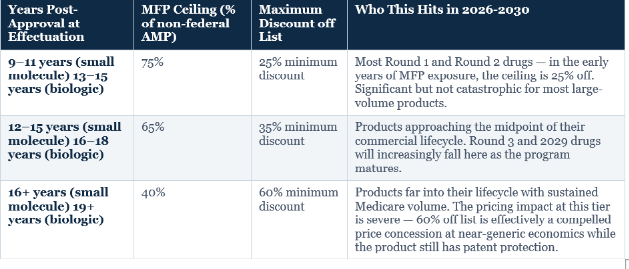
The third tier is the one that changes commercial strategy most dramatically. A product generating $3 billion in annual Medicare Part D revenue at sixteen years post-approval, subject to a 60% ceiling discount, faces a $1.8 billion annual Medicare revenue reduction relative to current pricing — while still under patent protection. That is not a revenue risk. It is a scheduled outcome that must be modeled into the product’s commercial trajectory from launch.
The Program Scale
The trajectory matters for portfolio planning. MFP coverage is not a fixed program targeting a small number of legacy products:
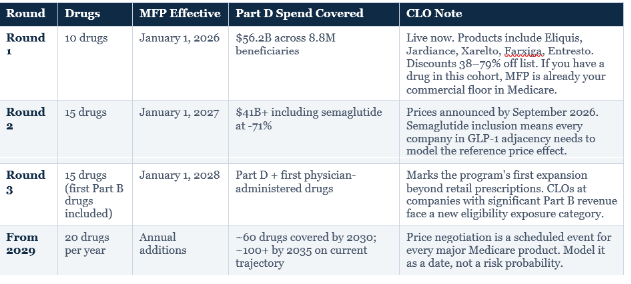
The cumulative impact compounds as the selection cohort grows. By 2030, approximately 60 drugs will be subject to MFPs. By 2035, more than 100. For any company with a significant Medicare Part D or Part B portfolio, this is not background regulatory noise. It is the structural pricing framework within which every major product’s commercial lifecycle will play out.
The Excise Tax
A manufacturer that refuses to participate in the negotiation program faces an excise tax on its total U.S. drug sales: starting at 65% and escalating to 95% if non-participation continues. Courts upheld this as a valid condition of participating in a voluntary federal program — the manufacturer can exit Medicare to avoid the tax. In practice, exiting Medicare Part D for a blockbuster product is commercially untenable. The excise tax is the compulsion mechanism. It is also why every constitutional challenge has failed: courts read the program as a voluntary arrangement where the exit option exists, even if it is commercially irrational. The CLO advising the board on the IRA should be precise on this point. The choice between accepting MFP negotiation and paying the excise tax is not a genuine choice for any product with significant Medicare volume. But that is a commercial reality, not a constitutional infirmity.
The Litigation History: What the Courts Said and What Remains
The pharmaceutical industry’s constitutional campaign against the IRA negotiation program began with seven simultaneous lawsuits filed in fall 2023. It has been comprehensively unsuccessful.
The courts’ reasoning on the Takings Clause was the most consequential legal holding. Manufacturers argued that the MFP imposed a taking of private property — their drugs, their pricing rights — without just compensation. Courts across multiple circuits rejected this: the Takings Clause does not prohibit the government from conditioning program participation on accepting its pricing terms when the manufacturer retains the ability to exit the program. Participation in Medicare is voluntary. The government’s pricing condition, even a severe one, does not become a taking when the participant has a formal exit option.
The First Amendment argument was more creative: the program’s offer letters and negotiation process required manufacturers to sign statements attesting to their participation, which the plaintiffs characterized as compelled speech. Courts rejected this too. The negotiation process is a commercial transaction, not a speech act. The government’s collection of pricing information and manufacturers’ responses to MFP offers are commercial conduct, not protected expression.
Due process arguments fared no better. Courts found that the program provides adequate procedural protections — the negotiation process, the dispute resolution mechanism, the public explanations of MFP calculations — to satisfy procedural due process requirements.
What remains: AbbVie’s statutory challenge. The argument is narrower than the constitutional campaign: not that the program is unconstitutional, but that CMS exceeded its statutory authority in specific implementation decisions — the calculation methodology for the MFP ceiling, the treatment of certain rebates and discounts in the non-federal average manufacturer price, and the adequacy of the administrative record supporting specific MFP determinations. Health Affairs noted in March 2026 that ‘while the courts appear to be closing pathways to facial constitutional challenges, the pharmaceutical industry is likely to continue making statutory claims.’ A successful statutory challenge could narrow specific methodological elements without invalidating the program. The Supreme Court cert window in the October 2026 term is the next significant litigation milestone to monitor.
THE ROUND 2 SEMAGLUTIDE INCLUSION
Semaglutide is included in Round 2 of the MFP program, with a negotiated MFP taking effect January 1, 2027, at a 71% discount off current list pricing. This has direct implications for any company in the GLP-1 market. The MFP creates a Medicare reference price floor that will influence commercial and Medicaid contracting discussions, investor revenue modeling, and competitive payer negotiations. Novo Nordisk is the manufacturer, and Novo has lost its federal appeals court challenge of the IRA negotiation program. The semaglutide MFP is set. Companies analyzing GLP-1 adjacency M&A or licensing deals need to model the post-MFP semaglutide pricing as the competitive reference point for their own programs.
What MFP Means for M&A: Three Diligence Items That Are Missing from Most Protocols
The IRA has added three specific items to pharma M&A diligence that most standard protocols have not incorporated. For any acquisition involving products with significant Medicare volume, each of these items is material.
MFP Eligibility Calendar
For every product in the target company’s portfolio, document: the FDA approval or licensure date; the molecule type (small molecule at seven years to eligibility, biologic at eleven years); the resulting earliest possible CMS selection date; and the earliest possible MFP effectuation date. Any product within five years of its eligibility threshold is a near-term MFP exposure. Any product already selected carries a known MFP. The eligibility calendar is the foundation for every other MFP-related analysis in the deal model.
MFP Impact on Revenue Projections
Standard pharma deal models project revenue through patent expiry with a price erosion curve beginning at LOE. That model is no longer accurate for any product with significant Medicare Part D or Part B volume approaching MFP eligibility. The revenue projection needs to incorporate: the MFP ceiling at each age tier (75%, 65%, or 40% of non-federal AMP); the estimated MFP discount at the product’s projected eligibility date (informed by comparable Round 1 and Round 2 outcomes); and the commercial spillover effect — the MFP creates a reference price that affects commercial and Medicaid negotiations even for patients covered outside Medicare. A product generating 40% of revenue from Medicare Part D whose deal model does not incorporate MFP pricing is a deal model built on assumptions that are no longer accurate.
Commercial Contract Change-of-Control Provisions Under MFP
The MFP creates new operational obligations at the dispensing level: the Medicare Transaction Facilitator (MTF) reporting requirements, patient attestation documentation, and the fourteen-day pharmacy refund reconciliation that Round 1 has operationalized and Round 2 will scale. An acquirer inheriting a commercial organization that has been managing these MFP compliance obligations needs to confirm that the infrastructure — the specialty pharmacy agreements, the hub services contracts, the MTF reporting architecture — is documented and transferable. Change-of-control provisions in specialty pharmacy agreements and hub services contracts may require renegotiation or consent. Those contracts were drafted before MFP compliance obligations existed, and many of them have not been updated.
What MFP Means for Life Cycle Management: The Decisions That Cannot Wait
The most consequential impact of the IRA on pharma legal strategy is not the constitutional litigation. It is the development strategy decisions that the pill penalty and the MFP ceiling formula are already reshaping — decisions that the CLO must be equipped to advise on because they are framed as development questions but are fundamentally IP and commercial law questions.
The Small Molecule vs. Biologic Decision
For any program at the research or early clinical stage where both a small molecule and a biologic approach are viable, the IRA adds a four-year pricing advantage to the biologic path. A biologic’s MFP exposure begins at thirteen years post-approval versus nine for a small molecule. For a product with $2 billion in annual Medicare revenue, four additional years of pre-MFP pricing is an $8 billion NPV difference at a 10% discount rate — before any adjustment for the ceiling discount differential. This calculation now belongs in every development stage gate review that involves molecule type selection. The legal function’s role is to ensure that IP strategy (patent term optimization, patent prosecution timing, extension opportunities) and commercial law (IRA compliance planning, MFP modeling) are represented in those gate reviews alongside the science.
Indication Sequencing and the Eligibility Clock
The MFP eligibility clock starts at the initial FDA approval date, not at the approval date for each additional indication. A small molecule approved in 2020 for Indication A becomes MFP-eligible in 2027 regardless of whether Indication B is approved in 2025 or 2029. This means that the commercial value of a new indication approval — which typically commands the same launch price as a new product — is constrained by the parent product’s MFP eligibility timeline. A company planning an additional indication launch for 2026 on a product approved in 2018 has at most three years of full commercial pricing before MFP eligibility arrives. The indication launch strategy and the MFP timeline must be modeled together.
Patent Term Extensions and MFP Timing
Patent term extensions (PTEs) and pediatric exclusivity extensions add commercial time to the end of the exclusivity period. They do not affect the IRA eligibility clock, which runs from FDA approval, not from patent expiry. A PTE extending commercial exclusivity to 2032 for a small molecule approved in 2017 adds nothing to the pre-MFP pricing window, because MFP eligibility arrived in 2024. The legal function has historically advocated PTEs purely for their exclusivity value. Under the IRA, their value must be evaluated against the MFP timeline: if MFP eligibility has already arrived, the PTE extends exclusivity at MFP pricing, not at launch pricing. That changes the NPV calculation for PTE prosecution strategy.
"Know a GC who'd find this useful? Forward it — that's how this grows"

Closing: The Litigation Taught Us Something Useful
The constitutional litigation generated three years of analysis about what the IRA’s negotiation program actually is: a conditional participation arrangement in a voluntary federal program, not a regulatory taking or a compelled commercial transaction. That analysis clarified the program’s legal foundation in ways that make the remaining statutory challenge — AbbVie’s claim that CMS exceeded its methodological authority — more readable. A narrow statutory win for AbbVie might adjust the MFP calculation methodology for specific parameters. It would not invalidate the program or restore unconstrained pricing for any of the products already subject to negotiation.
The CLO who treated the litigation as a live possibility that might restore the pre-IRA world was managing to a scenario that courts have now closed. The CLO who builds the MFP calendar, updates the diligence protocol, and integrates the pill penalty into development stage gates is managing to the world that exists. Those are different jobs, and the time to make the shift was January 1, 2026, when the first round of Maximum Fair Prices went live. The time to make it now is this week.
“Sixteen court losses is not a trend. It is a verdict. Maximum Fair Price negotiation is the commercial framework within which every major Medicare product will operate. The CLO who builds the governance structure for that framework is the one doing the job that 2026 requires.”
THE GC PLAYBOOK — RECENT ISSUES
The GC Playbook H1 2026 Deal Market Pulse (July 27, 2026)
Hikma v. Amarin: The Supreme Court’s Skinny Label Decision (July 6, 2026)
The GLP-1 Legal Wars: What 130 Lawsuits, FDA Enforcement, and the Compounding Pharmacy Fight Mean for Your Compliance Program
laroccaj.substack.com | Subscribe: $40/month or $400/year
