

Issue No. 3 | April 2026
FROM THE EDITOR
Private equity has been the single most consequential force reshaping the healthcare industry over the past decade. In 2024, the global value of healthcare PE deals reached $115 billion — the second-highest year on record. Biopharmaceutical and related services accounted for roughly $29 billion of that total. PE-led platform transactions led more than half of pharmaceutical industry deals in the 2022-2023 period. The money has been extraordinary. The returns, in many cases, have been extraordinary. And now the legal and regulatory environment is catching up — fast, from multiple directions simultaneously.
This issue is for the operating partner who has just acquired a specialty pharma platform and needs to build a legal function in 90 days. It is for the CLO at a PE-backed commercial-stage biotech who needs to brief a board composed of financial executives on why the company’s governance structure is now a regulatory compliance question. And it is for the GC at a PE firm’s portfolio company who is quietly wondering whether their company’s acquisition strategy is going to land their sponsor on the wrong end of an FTC complaint.
What I want to do in this issue is name the thing clearly: private equity has achieved a form of structural dominance in healthcare that regulators at the federal level, state legislators across the country, and — increasingly — the public, have decided requires a legal response. The response is not uniform. It is not always coherent. It is coming from different directions — antitrust, state corporate practice of medicine law, transaction review requirements, and board governance rules — that do not always fit together neatly. But it is real, it is accelerating, and it is creating compliance obligations that the legal function at every PE-backed healthcare company needs to own today.
I am going to give you the landscape, the specific legal risks it creates, and six workstreams that I believe the CLO at a PE-backed specialty pharma company should be running right now.
— John LaRocca
Founding Editor | LaRocca Law Group
■ PE PHARMA PLAYBOOK
The Legal Reckoning: How the Regulatory Environment Around PE Healthcare Dominance Is Reshaping the In-House CLO’s Job
Format: PE Pharma Playbook | Category: Antitrust + State Regulation + Board Governance
The Scale of the Thing: What “PE Healthcare Dominance” Actually Means
Before we get to the legal analysis, it is worth spending a moment on the scale of the phenomenon we are discussing, because the regulatory response only makes sense in context of the underlying commercial reality.
In 2024, global healthcare PE deal value reached $115 billion, the second-highest year on record. PE firms led more than half of all platform transactions in the pharmaceutical sector in the 2022-2023 period. The CDMO market — the contract development and manufacturing infrastructure on which the pharmaceutical industry depends — is valued at approximately $200 billion in 2025, is highly fragmented, and has become one of the hottest areas of PE healthcare investing. CROs now manage 75 percent of clinical trials globally.
What this means in practice: private equity owns an increasingly large share of the infrastructure through which drugs are developed, manufactured, tested, and distributed in the United States. And a smaller but growing share of PE healthcare investment is in the specialty pharma platforms that this newsletter is primarily written for — companies like the ones I have spent my career inside.
The regulatory concern is not that PE is investing in healthcare. It is that the combination of three specific PE structural features — the rollup acquisition model, portfolio company cross-ownership, and financial engineering under short holding periods — creates dynamics that regulators believe harm patients, workers, and the competitive structure of healthcare markets. Whether that belief is empirically correct is a legitimate debate. What is not debatable is that the belief has now produced laws, enforcement actions, and regulatory frameworks that are binding on PE-backed healthcare companies regardless of the underlying policy argument.
“The legal risk from PE healthcare dominance is not theoretical. It is operational. It is in the governance structure of your portfolio company, in the composition of your board, and in the strategy your sponsor approved at the investment committee.”
The Federal Antitrust Reckoning: From Welsh Carson to the New Normal
The federal antitrust story on PE healthcare rolls up around one case that every CLO and PE operating partner in this space should know in detail, because it established the template for what federal enforcement of PE rollup strategies looks like.
Welsh Carson and the Anesthesiology Rollup
In September 2023, the FTC made history by filing its first direct challenge against a PE-backed rollup strategy in healthcare: FTC v. U.S. Anesthesia Partners, Inc., S.D. Tex. 2023. The FTC alleged that United States Anesthesia Partners (USAP) and its PE sponsor Welsh Carson Anderson & Stowe had engaged in a systematic rollup strategy — acquiring nearly every large anesthesia practice in Texas — to create a single dominant provider with market power sufficient to extract supra-competitive prices from hospitals and payors.
The facts are instructive for any PE-backed specialty healthcare platform: Welsh Carson created USAP in 2012. Over the following years, USAP made approximately 10 acquisitions of large Texas anesthesia groups. By the time the FTC filed, USAP was the dominant anesthesia provider in the state. The FTC alleged that this was not organic competition — it was a designed concentration strategy, executed one acquisition at a time, each of which was individually below HSR reporting thresholds.
The district court dismissed Welsh Carson on procedural grounds in May 2024 — finding the FTC could not bring the case against the PE firm in federal court because the complaint did not allege Welsh Carson was currently violating the law. But the FTC secured a settlement with USAP itself in January 2025, imposing behavioral remedies that constrain USAP’s acquisition strategy going forward. The case sent three messages to the PE healthcare industry that have not been forgotten:
• The rollup model itself is a target. Serial acquisitions designed to create market dominance are subject to FTC scrutiny even if each individual deal is below HSR thresholds. The Commission will look at the pattern, not just the individual transaction.
• The PE sponsor can be named. Welsh Carson was dismissed on procedural grounds, not because the FTC’s theory of liability was wrong. Future cases will be structured to keep the sponsor in the complaint. The investment committee memo approving the rollup strategy is now a litigation document.
• The Trump FTC is not standing down. FTC Commissioner Andrew Ferguson stated explicitly in his concurrence in the Welsh Carson settlement that the Commission should treat PE the same as any other market participant — not as a special case deserving either protection or extra scrutiny. What that means in practice is that traditional antitrust analysis applies to PE-backed healthcare, and PE sponsors should not expect the ideological shift at the FTC under the new administration to provide immunity.
Interlocking Directorates: The Section 8 Threat That Is Already Landing
Section 8 of the Clayton Act, 15 U.S.C. § 19, prohibits any person from serving simultaneously as a director or officer of two competing corporations. This provision was largely dormant for decades. The Biden administration revived it aggressively for PE healthcare, and the Trump FTC has continued to enforce it.
The mechanism is simple: when a PE firm has portfolio companies in the same healthcare sector, it frequently places its own partners or operating executives on the boards of each. If those portfolio companies compete with each other in any meaningful market, the PE-appointed board members may constitute an illegal interlock under Section 8. In September 2025, three directors resigned from Sevita Health’s board in response to an FTC investigation — they had been serving concurrently on the boards of Sevita and Beacon Specialized Living Services, two competing providers of services to individuals with intellectual and developmental disabilities. Both were PE-owned.
The FTC’s Bureau of Competition has stated explicitly that it encourages all firms — including PE firms — to review their board memberships for competitive overlaps. The Section 8 exposure is not theoretical. It is an ongoing compliance obligation for every PE firm with multiple healthcare portfolio companies.
THE TRUMP FTC POSTURE: SAME ANALYSIS, DIFFERENT FRAMING
The Trump administration’s FTC has shifted the framing of PE healthcare scrutiny from “corporate greed” to traditional antitrust analysis. This matters because the legal tools being deployed — Section 7 of the Clayton Act for mergers, Section 8 for interlocking directorates, Section 5 of the FTC Act for unfair methods of competition — have not changed. What has changed is the political rhetoric. PE firms that read the change in administration as a green light for rollup strategies in concentrated healthcare markets are misreading the enforcement landscape. The tools are the same. The willingness to use them has not meaningfully diminished for transactions that clearly create market power.
The State Legislative Patchwork: CPOM, Transaction Review, and the New Compliance Burden
While federal antitrust enforcement has been the headline story, the more consequential development for PE-backed specialty pharma CLOs in 2025-2026 is the state legislative wave targeting PE ownership structures in healthcare. Multiple states have enacted or are pursuing laws that directly target the corporate practice of medicine (CPOM) doctrine, PE ownership of medical practices, and the MSO/PC structures that PE firms have historically used to maintain effective control while nominally complying with physician ownership requirements.
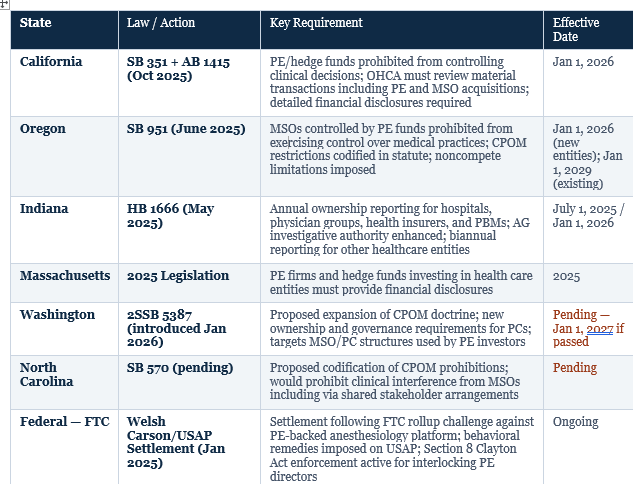
The pattern is clear: states are moving to close the structural loopholes that PE firms have used to exercise operational control over medical practices without technically owning them. The MSO/PC model — where a PE-owned management services organization provides management services to a physician-owned professional corporation under a long-term management agreement — has been the standard architecture for PE investment in physician practices for fifteen years. California, Oregon, Washington, and other states are now legislating directly against that structure.
For specialty pharma CLOs, the direct relevance of CPOM legislation may seem limited — specialty pharma companies are not physician practices, and the CPOM doctrine applies to the corporate practice of medicine by non-physician entities. But the same legislative trend that is targeting physician practice acquisitions is producing transparency and transaction review requirements that reach PE-backed specialty pharma companies, particularly where those companies own or operate specialty infusion, pharmacy benefit, or specialty distribution businesses. The California OHCA transaction review framework and the Indiana AG reporting requirements have broad enough definitions to capture a range of healthcare transactions beyond pure physician practice acquisitions.
THE COMPLIANCE GEOGRAPHY PROBLEM
The state CPOM and transaction review patchwork creates a multi-jurisdictional compliance problem for PE-backed specialty pharma companies with operations across multiple states. A transaction that is permissible in Texas may require pre-closing review in California, AG notification in Indiana, and would potentially trigger CPOM restrictions in Oregon. The CLO at a PE-backed platform company cannot rely on a single compliance framework — the company needs a 50-state map of transaction review obligations that is maintained in real time as the legislative landscape evolves. California, Oregon, and Indiana are the current enforcement-active states. Washington, North Carolina, and others are in the pipeline.
The CLO’s Specific Exposure: Where the Risks Actually Live
Let me now translate the regulatory landscape into specific legal risks that the CLO at a PE-backed specialty pharma company needs to have on their radar. The risk matrix below maps the primary exposure categories:
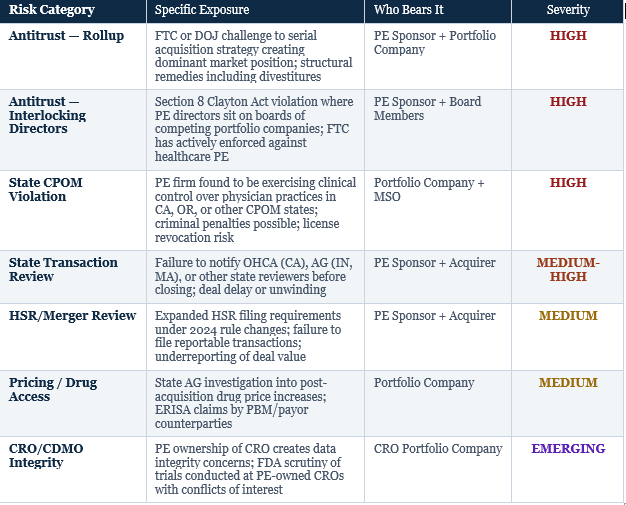
The risks I want to focus on for the rest of this analysis are the ones that are most distinctive to the PE-backed specialty pharma context — and most likely to be underestimated by a legal function that came up in the branded or generic pharma world rather than in PE-focused healthcare.
The Board Governance Risk That No One Is Talking About Loudly Enough
The Section 8 interlocking director risk does not sit in the compliance department or the regulatory team. It sits in the boardroom. The CLO of a PE-backed specialty pharma company has a professional obligation to advise the board on this exposure — and that means understanding the PE sponsor’s broader portfolio.
When a PE firm appoints two of its partners to your board, and those same partners sit on the board of another specialty pharma company in the sponsor’s portfolio that competes with your company in any meaningful product market, you potentially have a Section 8 violation. The CLO needs to know: (1) who else at the sponsor firm sits on competing boards; (2) how the FTC defines the relevant product markets in which your company operates; and (3) whether any current board composition creates a colorable Section 8 claim. This is not a hypothetical exercise. The FTC has demonstrated it will pursue interlocking director enforcement in PE-backed healthcare situations even under the Trump administration.
If you have not briefed your board on Section 8 compliance in the last 12 months, you are behind.
The Rollup Strategy Review: Your Investment Thesis May Be a Litigation Document
If your company’s growth strategy involves serial acquisitions of competitors or complementary businesses in a specialty pharmaceutical sector — think specialty generics rollups, specialty infusion pharmacy consolidations, or CDMO platform buildouts — the investment committee memo that approved that strategy, the board presentations that described the acquisition pipeline, and the financial projections that assumed market consolidation to achieve pricing power are all potentially discoverable in an FTC investigation or a state AG inquiry.
This does not mean the strategy is illegal. It means the CLO needs to ensure that the strategy is defensible: that each acquisition is independently justified on competitive grounds, that pricing strategy post-acquisition is not coordinated across acquired entities in ways that suggest anticompetitive intent, and that the company has a documented rationale for each deal that reflects legitimate business judgment rather than market foreclosure.
The discipline required is the same discipline any antitrust compliance program demands — but the PE-backed company context adds a layer of urgency because the PE sponsor’s portfolio-level strategy and the individual company’s acquisition strategy are being evaluated together by regulators.
The Two Things PE CLOs Get Wrong About This Moment
I want to close with the two strategic errors I see most frequently in PE-backed healthcare legal functions, because they are the ones most likely to create the preventable problems I have been describing.
Error One: Conflating Federal Enforcement Posture With Total Legal Risk
When the Trump administration’s FTC signaled that it would not “single out private equity for special treatment,” many PE-backed healthcare companies interpreted this as a relaxation of the regulatory environment. That interpretation is correct with respect to one dimension of the risk — the Biden-era rhetorical targeting of PE as a category of bad actor. But it is wrong with respect to the actual legal exposure.
The Welsh Carson settlement occurred in January 2025, under the Trump FTC. Section 8 enforcement continued throughout 2025. The state legislative wave is bipartisan — Indiana is a Republican state; Oregon is not. The CPOM restrictions in California, Oregon, and Washington are driven by physician advocacy and patient protection politics that cross party lines. The antitrust analysis of market concentration does not change when a new administration takes office. Rollup strategies that create dominant market positions are subject to challenge under any administration. The CLO who relies on the political climate as a compliance substitute is the CLO whose company becomes the next enforcement case study.
Error Two: Treating the Legal Function as a Transaction Execution Department
The second error is structural. In PE-backed companies, the legal function is frequently organized and resourced primarily around transaction execution — getting deals closed, managing outside counsel on M&A matters, handling contracts. These are important functions. But the governance, antitrust, and regulatory compliance workstreams I have described in this issue do not fit neatly into a transaction execution model. They require ongoing, proactive legal leadership that operates between transactions, not just during them.
The CLO at a PE-backed specialty pharma company is not just the deal lawyer. They are the person responsible for ensuring that the company’s ownership structure, governance arrangements, acquisition strategy, and regulatory posture are consistent with an evolving legal environment that is moving faster than most portfolio company boards realize. That requires a scope of responsibility — and a relationship with the board — that goes significantly beyond closing the next tuck-in acquisition.
Building that relationship, and that scope, is the long-term project this issue is designed to support.


Know a GC, CLO, or finance leader who’d find this useful? Forward it — genuinely, that’s how The GC Playbook grows.
And if your team has a raise, sale, or audit on the horizon, I take on a few diligence & compliance readiness reviews a year. Just reply to this email.
John (john@laroccaadvisory.com)
Six Workstreams for the CLO at a PE-Backed Specialty Pharma Company
