

FROM THE EDITOR
On September 22, 2026, Lexeo Therapeutics announced the acquisition of Mantle Therapeutics for $8.3 million upfront — $5.3 million in cash and $3.0 million in unregistered Lexeo common stock — with up to $13 million in contingent consideration payable over a 12-year milestone term. Simultaneously, Lexeo announced three research collaboration agreements with academic and industry partners to advance cerebellar-targeted gene therapy for Friedreich ataxia. Four transactions closed on the same day. The aggregate announced consideration was $21.3 million.
This deal will not appear in the BioBucks deal tracker. It is below the threshold that moves the aggregate M&A statistics. It is the kind of transaction that receives a paragraph in BioPharma Dive and a brief Globe Newswire release. It also contains four specific legal structures that CLOs at clinical-stage and pre-commercial biotech companies encounter regularly and that the GC Playbook has not addressed in depth: the SAFE cancellation at closing, the unregistered stock consideration, the long-tail milestone covenant with an explicit no-minimum-resource-commitment, and the simultaneous collaboration agreement IP architecture.
At Y-mAbs Therapeutics, I was the CLO of a rare disease company working in a small patient population with multiple therapeutic programs and a complex development environment. The legal work at a rare disease biotech does not look like the legal work at a commercial-stage specialty pharma company. The structures are different, the patient population dynamics shape the regulatory strategy differently, and the acquisition of a small private company with early-stage programs requires CLO capabilities that a company whose M&A experience is limited to large strategic transactions does not automatically have.
This article covers what makes the Lexeo/Mantle deal legally distinctive and what the CLO needs to execute correctly at each step.
— John LaRocca
Founding Editor | LaRocca Advisory Group
The Rare Disease Platform Acquisition: What the Lexeo / Mantle Deal Teaches About SAFEs, Unregistered Stock, and the 12-Year Milestone
Friedreich Ataxia and the Multi-Modality Platform Thesis
Friedreich ataxia is a progressive, multisystem genetic disease caused by deficiency of frataxin — a mitochondrial protein essential for iron-sulfur cluster assembly and energy metabolism. Approximately 5,000 individuals in the United States are affected; approximately 15,000 worldwide. Cardiac complications account for up to 80% of deaths in FA patients, with an average life expectancy of 35-40 years. There is no currently approved treatment specifically for FA cardiomyopathy.
Lexeo’s lead program — LX2006, an adeno-associated virus gene therapy designed to restore frataxin expression in cardiac tissue — is in its SUNRISE-FA 2 pivotal study with topline data expected in the second half of 2027. LX2006 received Orphan Medicinal Product designation from the European Commission in July 2024 and has FDA orphan drug designation. It has demonstrated sustained improvements across multiple cardiac biomarkers with no treatment-related serious adverse events in Phase 1/2.
The Mantle acquisition expands the platform beyond cardiac gene therapy in two specific ways. First, it adds non-gene-therapy modalities — oral small molecules, protein replacement, and RNA-based approaches — that could be used by patients who received or cannot receive gene therapy. Second, it adds CNS-targeted approaches that address the neurological manifestations of FA that systemic cardiac-targeted gene therapy does not reach. Lexeo’s strategic thesis: the FA patient needs both the cardiac program (LX2006) and the neurological program (the Mantle/collaboration portfolio), and no single modality addresses both.
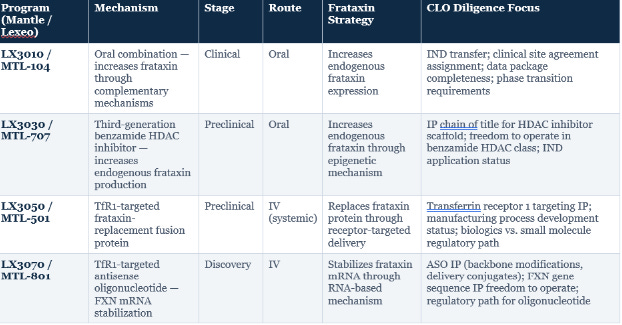
The multi-modality platform thesis has a specific legal architecture consequence: the CLO is not managing a single development program and a single regulatory relationship. The CLO is managing an AAV gene therapy IND, two or three small molecule development programs at different stages, a biologic (fusion protein) development program, and an oligonucleotide program — each with its own IP chain of title, regulatory path, manufacturing requirements, and collaboration agreement terms.
The Full Deal Structure: Consideration Components and CLO Issues
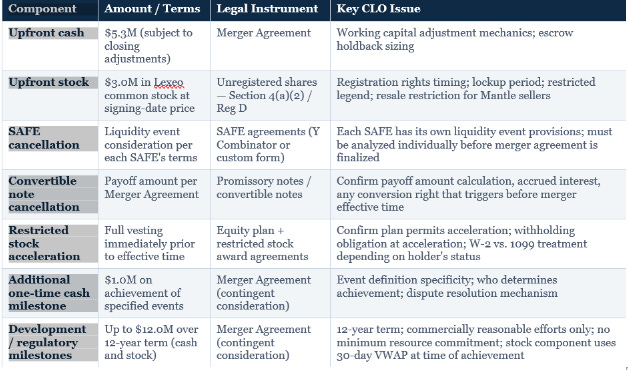
The Lexeo/Mantle merger agreement provides for a more complex consideration structure than the headline $8.3 million figure suggests. The table below maps each consideration component to its legal instrument and the specific CLO issue it creates.
Legal Structure 1: The SAFE Cancellation
Simple Agreements for Future Equity — SAFEs — are the dominant early-stage biotech financing instrument. Most pre-Series A biotech companies that have raised institutional capital have outstanding SAFEs, and most CLOs at clinical-stage public companies who have never been on the sell side of an early-stage acquisition have not managed SAFE cancellation at closing.
The SAFE is not equity. It is the right to receive equity on the occurrence of a specified triggering event. The standard Y Combinator SAFE converts into preferred stock at the price per share of the company’s next equity financing round — the ‘Next Equity Financing.’ A merger is typically defined in the SAFE as a ‘Liquidity Event’ rather than a Next Equity Financing. Under the standard SAFE liquidity event provisions, the SAFE holder receives either: (a) conversion into common stock at the price determined by dividing the Post-Money Valuation Cap by the Company Capitalization, or (b) a cash payment equal to the Purchase Amount (the amount originally invested), whichever is greater.
The specific CLO obligation before the merger agreement is finalized: every outstanding SAFE must be individually analyzed against its liquidity event provisions to determine the SAFE consideration each holder will receive at closing. The merger agreement states that SAFE consideration is ‘determined in accordance with the liquidity event provisions of each SAFE’ — meaning the merger agreement does not itself determine what the SAFE holders receive. The Shareholder Representative, acting on behalf of all Mantle equity holders, is responsible for confirming the SAFE consideration allocation, but the CLO overseeing the transaction must confirm that the SAFE analysis is complete and that the merger agreement’s consideration mechanics are consistent with each SAFE’s actual liquidity event terms.
Common errors in SAFE cancellation at acquisition: applying a single conversion price to all SAFEs when different SAFEs have different valuation caps or discount rates; failing to identify SAFEs that have MFN provisions entitling older SAFE holders to the better of their own terms and the most favorable terms subsequently granted; and failing to account for SAFEs held by parties who are also employees, which creates a tax characterization question about whether the SAFE proceeds are capital gains or ordinary income.
Legal Structure 2: Unregistered Stock Consideration
The $3.0 million stock component of the upfront consideration — and any stock-denominated milestone payments over the 12-year milestone term — are issued as unregistered Lexeo common stock under Section 4(a)(2) of the Securities Act and/or Regulation D. The shares are not registered under the Securities Act. The Mantle sellers who receive them cannot sell them in the public market until either a registration statement covering their resale is declared effective, or an exemption from registration is available (typically Rule 144, which requires a holding period of six months for non-affiliates and one year for affiliates of the issuer).
The negotiated terms that determine the real value of the stock consideration:
• Registration rights: Does the merger agreement include registration rights for the unregistered shares? Demand registration rights (the seller can demand a registration statement) or piggyback registration rights (the seller can include their shares in a registration statement Lexeo files for other purposes) determine when the shares become freely tradeable. Registration rights with a 6-month filing deadline are materially more valuable than registration rights that allow Lexeo to delay registration indefinitely.
• Lockup period: Even if registration rights are included, many merger agreements include a lockup period during which the selling shareholders agree not to sell the registered shares. The lockup period is a negotiated concession by the sellers in exchange for certainty of closing or other terms.
• VWAP mechanics for milestone stock: The milestone payments are payable in ‘shares of Common Stock valued using a thirty-day trailing volume-weighted average price based on the date of achievement of such milestone.’ Twelve years from closing, Lexeo’s stock price may be materially different from what it is today. The VWAP mechanic is standard for stock-denominated milestone payments — it prevents gaming of the share count by reference to a single day’s price — but the milestone payees should understand that the dollar value of the stock they receive depends on Lexeo’s stock price at the time of achievement, not at closing.
Legal Structure 3: The 12-Year Milestone — Reading the Covenant
The Merger Agreement provides for up to $12 million in milestone payments over a 12-year term, payable upon achievement of ‘specified development and regulatory milestones relating to Mantle’s product candidates.’ The Merger Agreement also states, in language that is unusually explicit for a contingent consideration structure: ‘Lexeo makes no guarantees that it will achieve any milestone, and the Merger Agreement does not require Lexeo to devote any particular level of resources to the development or commercialization of Mantle’s product candidates beyond the commercially reasonable efforts standard set forth in the Merger Agreement.’
This language is important. Commercially reasonable efforts is the weakest effort standard available in an M&A milestone structure. It does not require a minimum R&D spend, a minimum headcount devoted to the program, a specified timeline for development activities, or any specific commitment to advance the program to clinical testing. It requires only that Lexeo pursue the milestones with the effort that a company of similar resources and capabilities would devote to a similar program in similar circumstances — a standard that gives Lexeo substantial discretion in how it prioritizes the Mantle programs against LX2006 and its other pipeline.
The 12-year milestone term means that some or all of the milestones remain payable for more than a decade after closing. A program that is currently in the discovery stage — LX3070 — could theoretically advance to regulatory approval within that window, but the timeline is not guaranteed and the effort standard does not require Lexeo to advance it on any particular schedule. The Mantle sellers who negotiated milestone consideration in lieu of higher upfront consideration accepted the risk that those milestones may take the full 12 years to trigger — or may never trigger.
For the CLO at a company acquiring pre-commercial programs with long-tail milestone structures, the lesson is direct: the milestone payment’s commercial value to the seller is inversely proportional to the length of the milestone term and the weakness of the effort standard. A 12-year milestone with a CRE standard and no minimum resource commitment is a contingent payment that may never be made. If the CLO’s client is the seller, negotiate a shorter milestone term, a stronger effort standard, or higher upfront consideration in exchange for the contingent risk.
The Four Acquired Programs: IP and Regulatory CLO Obligations
Legal Structure 4: The Simultaneous Collaboration Agreements
Three research collaboration agreements were signed on the same day as the Mantle merger agreement. Each collaboration is a separate legal instrument — a research collaboration and license agreement — with its own IP terms, governance structure, and milestone economics. The simultaneous announcement of four transactions (one merger, three collaborations) is a platform-building strategy, not an accident. It is also a significant CLO workstream.
The specific IP issues in each collaboration:
• Background IP vs. Foreground IP: Each collaboration agreement must define what technology each party brings to the collaboration (background IP) and what technology is developed in the collaboration (foreground IP, also called ‘program IP’ or ‘collaboration IP’). The allocation of ownership and licensing rights to foreground IP determines who controls the commercial development of any discovery made in the collaboration. For a cerebellar gene therapy collaboration where the academic partner contributes CNS delivery expertise and Lexeo contributes the frataxin gene payload, the question of who owns the optimized delivery vector — which may have applications beyond Friedreich ataxia — is a negotiation point with significant commercial consequences.
• Publication rights: Academic collaboration partners require the right to publish research results. The collaboration agreement must give Lexeo a review period before publication — typically 30-60 days — to identify patentable inventions in the manuscript and file patent applications before the public disclosure that would defeat the novelty requirement. A collaboration agreement whose publication rights clause allows immediate publication without a Lexeo review window is a collaboration agreement that may inadvertently destroy patentable IP in Lexeo’s own platform.
• Right of first negotiation: If the collaboration produces a result that neither party developed alone — a novel delivery system, a new therapeutic modality — the collaboration agreement should give Lexeo a right of first negotiation to license or acquire the collaboration’s output before the academic partner can offer it to a third party. The ROFN window (typically 60-90 days) and the trigger event (disclosure of the collaboration result to the partner, not publication) are the specific terms that determine whether the ROFN provides meaningful protection.
• Exclusivity scope: Is the collaboration exclusive to Friedreich ataxia, or does it restrict Lexeo’s ability to use the developed delivery technology in other rare neurological disease programs? An exclusive collaboration in a broad technology area — TfR1-targeted delivery, for example — could prevent Lexeo from using the developed technology for programs outside FA without the collaboration partner’s consent. The exclusivity scope should be defined specifically by indication, target, and modality.
FRIEDREICH ATAXIA ORPHAN DRUG DESIGNATION — WHAT LEXEO ALREADY HAS AND WHAT IT NEEDS TO MAINTAIN
LX2006 holds FDA Orphan Drug Designation for Friedreich ataxia and EMA Orphan Medicinal Product designation. These designations provide: 7 years of U.S. market exclusivity post-approval; 10 years of EU market exclusivity; clinical development cost offsets (25% U.S. tax credit, waived FDA application fees). The Mantle programs — acquired at clinical, preclinical, and discovery stage — do not automatically inherit Lexeo’s ODD. Each Mantle-derived program that seeks FDA approval in FA will require its own Orphan Drug Designation application, its own clinical development data, and its own exclusivity period. The FA indication has roughly 5,000 U.S. patients — comfortably within the ODD threshold of 200,000. The CLO managing the FA platform should confirm ODD status for each program independently and track maintenance obligations (ODD holder must report to FDA annually on development progress).
WORKSTREAM 1 IMMEDIATE
Complete the SAFE Inventory and Liquidity Event Analysis Before the Merger Agreement Is Executed
Before signing any merger agreement with a private early-stage target, the CLO must ensure the complete SAFE inventory analysis is done and reflected in the merger agreement’s consideration mechanics. The SAFE inventory covers: the aggregate principal amount of each outstanding SAFE; the valuation cap and discount rate for each SAFE; the MFN provisions in any SAFE; the liquidity event formula for each SAFE (valuation-cap conversion price vs. return of Purchase Amount — which is greater?); and the tax characterization of SAFE proceeds for each holder (capital gains vs. ordinary income depends on whether the SAFE is treated as equity for tax purposes, which in turn depends on the SAFE’s structure and the issuer’s election). The Shareholder Representative will make the allocation calculations, but the CLO should confirm the methodology before the merger agreement is signed. A merger agreement whose consideration waterfall is inconsistent with the actual SAFE terms will produce allocation disputes at closing that delay the transaction and create litigation risk.
BUSINESS IMPACT: A SAFE analysis error that surfaces at closing — when the consideration waterfall produces a different result for a SAFE holder than their instrument entitles them to — is an error that either delays closing or produces a post-closing securities law claim by the SAFE holder who received less than they were owed.
WORKSTREAM 2 NEAR-TERM
Negotiate Registration Rights for the Unregistered Stock Consideration
In any acquisition where the acquirer is a NASDAQ- or NYSE-listed company issuing unregistered stock as consideration, the CLO for the target company should negotiate registration rights as a closing condition or as a covenant in the merger agreement. Specifically: demand registration rights exercisable at any time after six months from closing, with a filing deadline for the registration statement of 60 days following the demand; an automatic shelf registration obligation if the acquirer qualifies as an S-3 registrant (most NASDAQ-listed companies do); piggyback registration rights for any public offering the acquirer conducts in the 12 months following closing; and no lockup period beyond six months from closing. The CLO for the acquirer should resist unconditional demand registration rights and negotiate a six-month lockup as the standard concession. Either way, the registration rights negotiation is not a detail — it determines when the stock consideration becomes liquid and therefore what its present value is to the sellers.
BUSINESS IMPACT: Unregistered stock consideration with no registration rights, a one-year lockup, and a 12-year milestone stock component creates seller consideration that may be effectively illiquid for years. The sellers who accepted that structure understood its value. The CLO who did not negotiate registration rights left value on the table for their client.
WORKSTREAM 3 STRATEGIC
Build the Platform IP Map and Orphan Drug Designation Maintenance Calendar
After closing a multi-modality rare disease platform acquisition, the CLO’s most durable contribution is the platform IP map — a document that inventories every IP asset in the combined portfolio by program, modality, and stage; maps the ownership and licensing chain for each IP asset; identifies the freedom-to-operate analysis status for each program; and confirms the orphan drug designation status and maintenance obligations for each program. For the Lexeo platform post-Mantle, the IP map covers: LX2006’s AAV gene therapy IP chain; LX3010’s oral combination IP; LX3030’s benzamide HDAC inhibitor IP; LX3050’s TfR1-targeted protein replacement IP; LX3070’s TfR1-targeted ASO IP; and the collaboration-derived IP from each of the three research collaborations. The orphan drug designation maintenance calendar confirms: which programs have FDA ODD, which have EMA OMP, which need ODD applications, and what the annual reporting obligations are for each designation. This map does not exist at closing — the CLO builds it in the 90 days following closing.
BUSINESS IMPACT: A rare disease platform company that does not have a current IP map and ODD maintenance calendar is a company that cannot answer the basic diligence questions a potential acquirer, partner, or co-development counterparty will ask. The CLO who builds the map in the quarter following closing provides a tool the company will use for the duration of the platform.
“The $8.3 million upfront acquisition contains the SAFE cancellation mechanics, the unregistered stock considerations, the long-tail milestone covenant, and the collaboration IP architecture that a CLO at any clinical-stage biotech needs to understand. The size of the deal does not determine the complexity of the legal work.”
For interested readers I have prepared a Rare Disease Platform Acquisition Protocol. It can be found at: http://laroccaadvisory.gumroad.com/

ABOUT THE AUTHOR
John LaRocca is a pharma and biotech attorney with 26 years of in-house experience, including CLO/GC tenures at Actavis, Eagle Pharmaceuticals, Aerie Pharmaceuticals, and Y-mAbs Therapeutics. He is the founding partner of LaRocca Advisory Group, a boutique fractional CLO services firm. The GC Playbook reflects his personal views and does not constitute legal advice.