

The biotech funding picture has changed dramatically since the post-pandemic boom. In 2021, money was cheap, NIH and NSF grants were flowing, and VCs were writing checks with enthusiasm. That environment produced an explosion of patent filings — companies protecting everything they could touch, because the cost felt manageable against the backdrop of seemingly unlimited capital.
Today’s math is different.

According to the EY Biotech Beyond Borders 2026 report, 33% of biotech companies ended 2025 with less than one year of cash remaining — and another 23% had only one to two years. That’s 56% of the industry running on fumes, compared to 40% in 2021. The shift reflects a brutal convergence: higher interest rates, reduced government research funding, tariff uncertainty, and a venture community that has turned decidedly cautious.
Against that backdrop, many biotechs are conducting a hard-eyed review of every cost center. IP portfolios — often among the largest line items outside of clinical programs — are getting scrutiny they rarely received during the boom years. That scrutiny is overdue. And for in-house counsel and GCs at smaller companies, it creates both an obligation and an opportunity.
“The IP portfolio review is no longer optional — it’s a fiduciary exercise.”
The Real Cost of Global Patent Prosecution
Filing a patent application feels like an investment. Prosecuting it through to grant — in every jurisdiction where you want protection — is where the spend compounds quickly and quietly.
Pursuing comprehensive global protection for a single application can run up to $1 million when you aggregate prosecution costs, annuities, and translation requirements across major markets. That number is before divisional applications — and divisionals are not optional. Managing a product’s patent lifecycle almost always requires filing off the original application, each carrying prosecution costs comparable to the parent. For a company with multiple active patent families, the aggregate exposure is substantial.
Here is the harder truth: for large pharma, this is a rounding error. It is also — frankly — career-safer for IP decision-makers at big companies to keep prosecuting a marginal patent family than to abandon it and later be held responsible if it turns out to have value. That institutional logic does not apply at a 40-person biotech with 14 months of runway.
“The portfolio you built for the last financing round may not be the portfolio you need now. Misalignment between IP strategy and business objectives is one of the most expensive problems that never appears on a P&L.”
Strategic Triage: Aligning the Portfolio to Current Business Objectives
Small and mid-size biotechs must approach IP with a level of strategic discipline that large pharma rarely practices. The relevant questions are not just patentability — they are commercial. A meaningful portfolio triage requires asking four things about every active patent family:
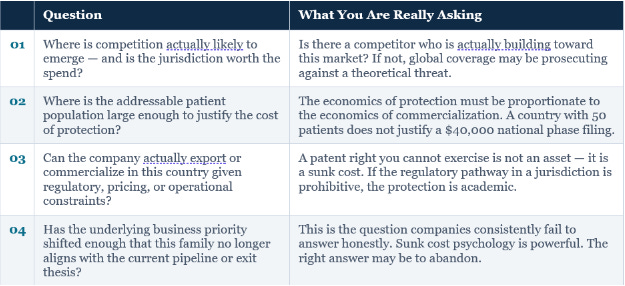
The fourth question is the one companies consistently fail to answer honestly. Sunk cost psychology is powerful. Teams that spent two years and several hundred thousand dollars prosecuting an application are not well-positioned to recommend abandoning it. But good investors — the ones you actually want at the cap table — are not impressed by large patent portfolios for their own sake. They want to see focused protection of the assets that matter, in the markets that make sense, with a clear line to value.
How well does your current portfolio map to your actual business objectives? If you cannot answer that question in five minutes, that is your first deliverable.
Beyond Patents: Exclusivity and Trade Secrets as Cost-Effective Complements
Patent prosecution is not the only tool available to protect competitive position. For cash-constrained companies in particular, two non-patent strategies deserve serious attention alongside the portfolio triage.
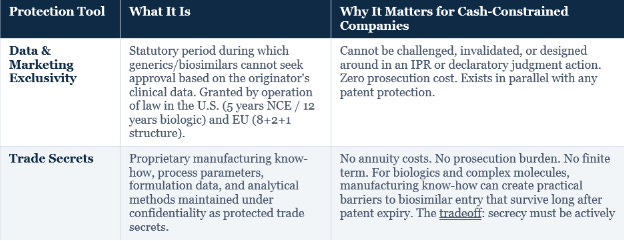

“Exclusivity cannot be challenged. Trade secrets do not expire. Neither requires a prosecution budget. These are not fallback positions — they are strategic tools that deserve a place at the table alongside your patent strategy.”
The GC’s Role: Forcing the Conversation
IP strategy at most small biotechs lives primarily with the scientific founders or an outside patent firm. The GC’s job is to ensure it does not stay there — and to inject the business and financial context that pure IP counsel may not be positioned to provide.
That means three specific actions in the current environment:
• Schedule a formal portfolio review against current pipeline and commercial priorities. Not a legal audit — a business alignment exercise. Put it on the agenda before the next board meeting.
• Ask the CFO and CEO to quantify annual IP spend as a percentage of runway. Most leadership teams at small biotechs do not have that number readily available. They should. When they see it expressed as months of cash rather than as an annual dollar figure, the conversation changes.
• Ensure that IP counsel — inside or outside — understands both the legal and the business dimensions of the portfolio. The right advisor does not just prosecute applications; they help you decide which ones to stop prosecuting. That requires a different kind of engagement than most outside patent firms are hired to provide.
The companies that will come out of this period in the best position are not necessarily the ones with the biggest portfolios. They are the ones that made deliberate, defensible decisions about what to protect and what to release — and documented the reasoning. In a funding environment where 56% of the industry is running on two years or less, that discipline is not a competitive advantage. It is a survival requirement.
EDITOR’S NOTE
The GC Playbook welcomes contributions from specialist practitioners whose expertise is directly relevant to our readership. Guest contributors are selected by the editor based on subject matter depth and alignment with the issues facing in-house legal teams in pharma and biotech. William Coppola has no current financial relationship with LaRocca Advisory Services.
ABOUT THE GUEST CONTRIBUTOR
William Coppola has served as Distinguished Practitioner in Residence at the Gibbons Institute of Law, Science and Technology at Seton Hall University School of Law, where he also serves as Adjunct Professor. An accomplished pharma and biotech patent attorney, he has secured and defended worldwide patent protection for chemical, biotechnology, and device inventions, and has litigated patents in Hatch-Waxman proceedings in the United States and PMNOC proceedings in Canada. He holds a J.D. from Seton Hall University School of Law, a graduate degree in Biochemistry from the University of South Florida, and an undergraduate degree in Chemistry from the University of Delaware. He is a registered patent attorney in New Jersey, New York, Florida, and the District of Columbia. He previously served as Intellectual Property Counsel at Aerie Pharmaceuticals, Senior Patent Attorney at Sanofi, and Patent Counsel at Aventis Pharmaceuticals.
© 2026 The GC Playbook | All rights reserved | Not for redistribution without permission